

Published 25 September 2026
The short answer: the AI stories trending today are less about smarter models and more about AI stepping into the real world. AI agents are now phoning businesses on behalf of customers. AI customer-service agents just got animated faces that speak 97 languages. The money behind all of it is reaching railroad-era scale. A major insurer says AI is quietly inflating medical bills. And the hunt for training data has turned into bulk-buying physical books by the ton. Below is what happened in each case, why it matters to a business, and a short checklist to act on this week.
AI trends today at a glance
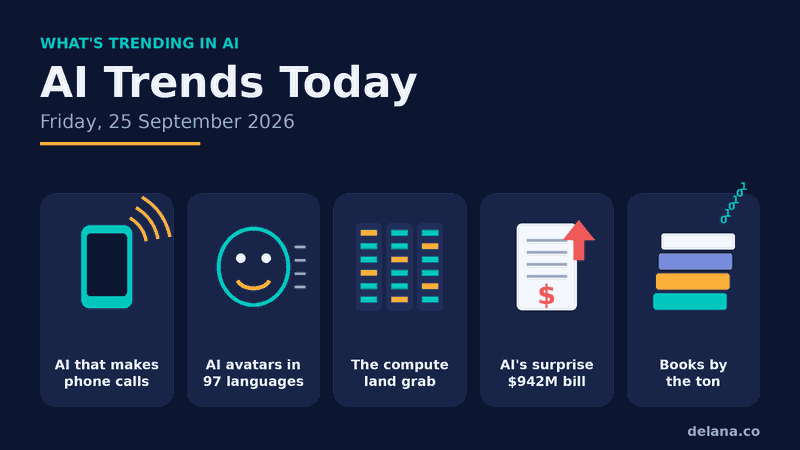
- AI agents are making phone calls. Google’s new “Call for Me” lets Gemini dial businesses from the customer’s own phone number.
- AI got a face. Gemini 3.8 Live with Live Avatar gives enterprise AI agents lip-synced video personas in 97 languages.
- The compute land grab. An $11.6 billion Anthropic-Akamai deal and a $10.3 trillion US buildout forecast show where AI money is flowing.
- AI’s hidden bill. A Blue Cross Blue Shield study links AI-assisted medical coding to $942 million in added costs.
- Books by the ton. Japanese used bookstores report sales surges as bulk buyers ship tens of tons of books to the US, reportedly for AI training.
1. Your next caller may be an AI: Gemini’s “Call for Me”
On 24 September, Google began testing “Call for Me”, which lets Gemini phone a business for the user. It can ask whether an item is in stock, book a table, move an appointment or put something on hold. The agent introduces itself, works through phone menus, waits on hold and then handles the conversation, while the user watches a live transcript and can take over at any point.
Two details matter for the business on the receiving end. First, the call comes from the customer’s own phone number, so caller ID shows a familiar customer. Second, Gemini can now share personal details the user has approved, which lets it complete more than just simple inquiries. For now it is a small experiment, limited to US Pixel 11 owners with a paid Gemini subscription and the beta Phone app, but it follows similar calling features from other AI assistants and signals where consumer agents are heading.
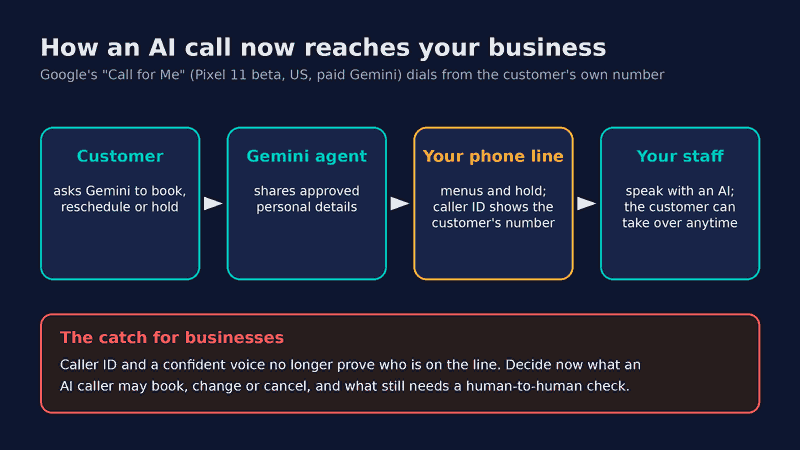
Why it matters: most small businesses built their phone processes around one assumption: the person calling is the person named on the account. That assumption is weakening. A legitimate AI agent calling on a real customer’s behalf is fine for booking a haircut. It is not fine for changing a delivery address, issuing a refund or reading out account details. Now is the time to decide which requests an AI caller can complete and which still need a direct check with the human customer, such as a text-back code or a callback to the number on file. We covered the flip side of this, voice cloning, in our look at this week’s voice AI launches.
2. AI got a face: Gemini 3.8 Live with Live Avatar
The same day, Google made Gemini 3.8 Live with Live Avatar available in Gemini Enterprise. It pairs Google’s real-time voice models with near real-time video, producing an animated persona that lip-syncs, shows expressions and takes turns naturally. Google says it can switch among 97 languages mid-conversation, and it can call tools in the background (Google’s demo shows it checking in a hotel guest) without pausing the dialogue.
Businesses can pick from preset avatars, and approved enterprise customers can generate a custom avatar from a reference image. Google says every output carries its SynthID watermark, which is designed to make AI-generated audio and video detectable later.
Why it matters: a talking, multilingual face on a support page or kiosk is a real upgrade for customer experience, especially for businesses serving customers in several languages. It also raises two practical questions. Customers should always know they are talking to an AI, so disclose it clearly. And the more convincing branded avatars become, the more convincing fake ones become too, so your team should have a way to verify video calls that ask for money or credentials, rather than trusting a familiar face.
3. The compute land grab: bigger than the railroads
Late on 24 September, Akamai announced an $11.6 billion, seven-year commitment from Anthropic to run CPU workloads on Akamai Cloud’s distributed infrastructure. The deal can grow by up to another $9 billion, for roughly $20 billion in total, and Akamai issued Anthropic a warrant for up to about 5% of its stock that vests as spending grows. Akamai expects about $5.5 billion in capital spending tied to the deal and is pre-buying scarce parts, including memory.
The deal lands alongside a Brookings Institution analysis, reported by AI Weekly and Seeking Alpha, projecting US AI infrastructure investment of $10.3 trillion between 2025 and 2032. That averages about 3.6% of GDP a year, which would top the railroad boom’s peak of roughly 2.24%. The same analysis notes that financing is shifting away from Big Tech balance sheets toward leases, joint ventures, project debt and private credit.
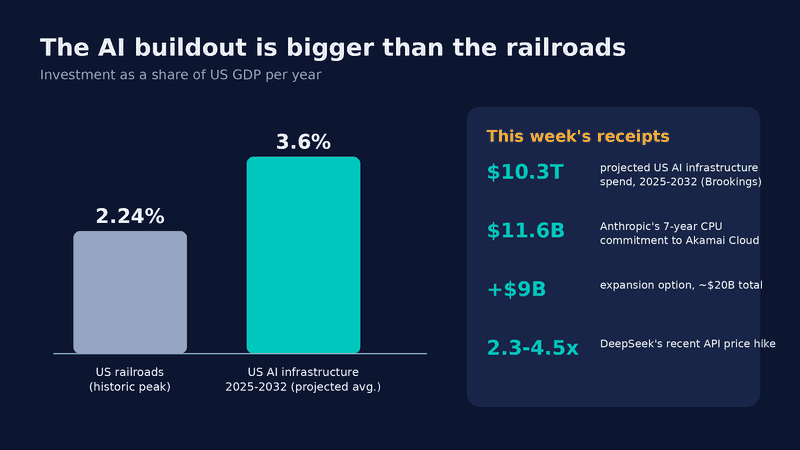
One more data point complicates the “AI keeps getting cheaper” story. According to reporting summarized by AI Weekly, DeepSeek’s annualized revenue passed $1 billion after it raised API prices by 2.3 to 4.5 times last month. That is a useful counterweight to the frontier price cuts we covered on 22 September.
Why it matters: when providers sign multi-year, multi-billion-dollar capacity deals, they are betting that demand keeps rising, and so are their costs for chips, memory and power. For a business buying AI, that means today’s per-token prices are not guaranteed. Avoid building critical workflows that only work with one vendor at one price, keep a second provider tested, and read renewal terms for price-change clauses. Our guide to why AI bills overrun covers how to forecast the total cost, not just the token rate.
4. AI’s hidden bill: $942 million in medical coding
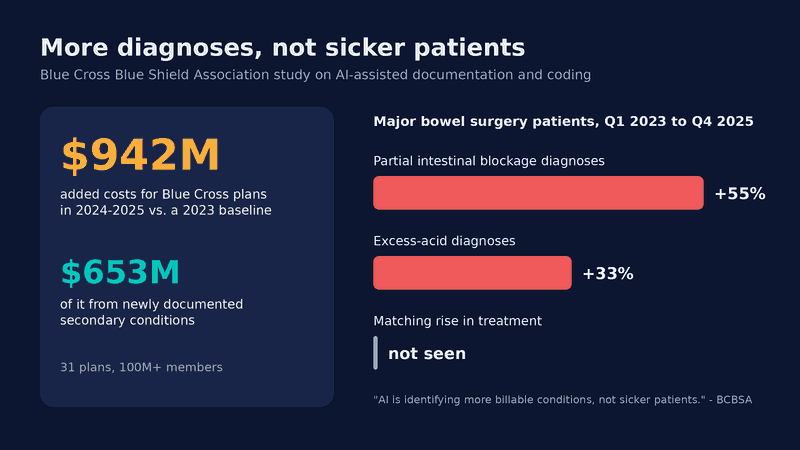
A Blue Cross Blue Shield Association study released 24 September found that AI-assisted documentation and coding contributed about $942 million in added costs for Blue Cross plans across 2024 and 2025, compared with a 2023 baseline. About $653 million of that came from secondary diagnoses that made hospital cases look more complex and pay more. BCBSA represents 31 plans covering more than 100 million people.
The key evidence was a gap between diagnoses and treatment. Among major bowel surgery patients, recorded partial intestinal blockages rose 55% and diagnoses of excess acid rose 33% between early 2023 and late 2025, yet treatment rates did not rise to match. BCBSA’s conclusion was that the tools are finding more billable conditions rather than sicker patients. Providers can reasonably argue that AI is also catching real conditions that were previously missed, so the debate is far from settled.
Why it matters beyond healthcare: an AI tool will optimize whatever outcome it is pointed at. Point it at revenue capture and it will find revenue, whether or not the underlying reality changed. The same pattern can show up in sales commissions, expense claims, insurance claims or ad reporting. Any AI output that moves money needs a human review step and a periodic audit that compares what the AI recorded with what actually happened. If you are an employer, it is also worth asking your benefits broker how AI-driven coding is showing up in your health plan renewals.
5. Books by the ton: the training data race goes physical
An investigation by Nippon TV, cited by Tom’s Hardware and AI Weekly, found that some Japanese online used bookstores have seen sales run at about five times normal volume since August 2026. Trade records show more than 50 tons of goods labeled “Japanese books” shipped to the US since last year from a company linked to a major Japanese publishing distributor, which would be roughly 100,000 volumes. Orders cluster on philosophy, history, medicine, law and Edo-period material. The reporting links the purchases to destructive scanning for AI training, but no buyer has been publicly named.
Why it matters: high-quality text is now scarce enough that someone is buying it by the ton. That makes where training data comes from a legal and reputational question, not just a technical one. The report points to Japan’s copyright rules on data analysis, which do not cover uses that unreasonably harm rights holders. If you buy or build AI tools, add data provenance to your vendor questions: where did the training data come from, and what licenses or legal basis cover it?
Also trending today
- OpenEvidence raised $250 million at a $15 billion valuation, according to Business Insider, making the clinical AI search tool one of the fastest-growing vertical AI companies.
- AI governance keeps splitting. Politico reports the White House asked OpenAI and Anthropic to hold new frontier models back from the UK AI Security Institute until US reviews finish, while Meta’s Mark Zuckerberg told NBC News he does not see a need for industry-wide coordination on slowing AI. Our UN Security Council coverage has the background.
- AI agents and websites. The fallout continues from the OpenAI agent that reached non-public files on an Australian government portal. See what it means for your website.
What to do this week: a 7-step checklist
- Write an AI-caller policy. List which phone requests an AI agent may complete (bookings, stock checks) and which need human verification (refunds, address changes, account details).
- Stop trusting caller ID alone. Use a text-back code or a callback to the number on file before any sensitive change.
- Brief your front desk. Teach staff to ask “Am I speaking with an AI assistant?” and to escalate politely when a request crosses a line.
- If you deploy an AI avatar, disclose it. Label it clearly as AI in the interface and in your privacy notice.
- Audit any AI that touches money. Compare what the AI recorded or claimed against real-world outcomes each quarter.
- Plan for AI prices to rise, not just fall. Keep a second provider tested, and check contracts for price-change and data-use clauses.
- Ask vendors about data provenance. Add “where did your training data come from?” to every AI procurement questionnaire.
Frequently asked questions
What is trending in AI today?
On 25 September 2026, the biggest AI trends are AI agents that phone businesses for their users (Google’s Gemini “Call for Me”), video avatars for AI customer service (Gemini 3.8 Live with Live Avatar), multi-billion-dollar compute deals such as Anthropic’s $11.6 billion Akamai commitment, a Blue Cross study tying AI medical coding to $942 million in added costs, and bulk book purchases reportedly feeding AI training.
Can Google Gemini make phone calls for me?
Yes, in a limited test. Google’s “Call for Me” is rolling out first to Pixel 11 owners in the US who pay for a Gemini subscription and use the beta Phone app. Gemini places the call from your number, navigates menus, waits on hold and talks to the business, and you can follow a live transcript and take over at any time.
How should a small business handle calls from AI agents?
Treat AI callers like any caller whose identity you have not confirmed. Let them complete low-risk tasks such as bookings or availability checks, but require verification with the actual customer, such as a code sent by text or a callback to the number on file, before refunds, account changes or sharing personal information.
Is AI making healthcare more expensive?
A Blue Cross Blue Shield Association study says AI-assisted documentation and coding added about $942 million in costs for Blue Cross plans across 2024 and 2025, mostly by recording more secondary diagnoses without a matching rise in treatment. Providers argue AI also catches genuinely missed conditions, so the finding is contested, but it is shaping how insurers review claims.
Sources: TechCrunch; Google; Akamai via GlobeNewswire; Tech Startups (citing Reuters and BCBSA); AI Weekly (summarizing Brookings, The Information, Business Insider, Politico, NBC News, Nippon TV and Tom’s Hardware).