

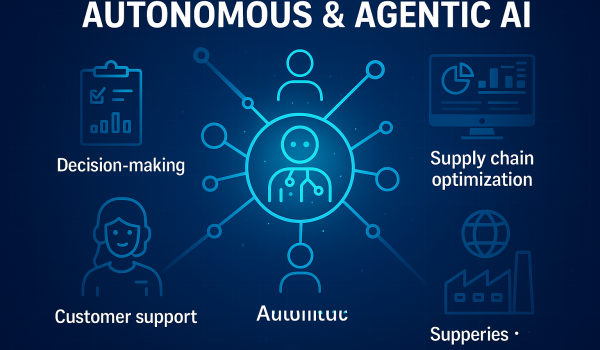
AI is moving from assistance to autonomy. For the past few years, most business AI has worked like a capable assistant: you ask, it answers, and you decide what to do. Agentic AI systems go further. Given a goal, they plan the steps, gather information from multiple systems, take actions, check the results and adjust, often without a person approving each step.
That shift is less about any single breakthrough and more about maturity. Models have become better at reasoning through multi-step tasks, and standard ways for them to connect to business software have emerged. The result is that self-directed agents are starting to handle real work in decision support, customer service and operations. The question for most organizations is no longer whether to use them, but where to start and how much independence to grant.
What makes an AI system autonomous
An AI agent combines four elements: a language model that reasons about the task, tools it can call such as databases, APIs, email or a browser, memory of what it has done so far, and a goal or set of instructions that defines success. The agent loops through planning, acting and observing until the task is complete or it needs help.
Two developments in 2024 and 2025 made agents much easier to build. Anthropic’s Model Context Protocol, released in November 2024, gave developers a standard way to connect models to tools and data sources, and it has been widely adopted across the industry. Google’s Agent2Agent protocol, announced in April 2025, targets communication between agents built by different vendors. Standards like these mean an agent can work across your CRM, ticketing system and ERP without a custom integration for each.
Where agents are delivering value
The strongest early use cases share three traits: high volume, clear rules, and outcomes that can be checked.
- Decision support with real-time data. Agents can monitor dashboards, pull data from several systems, and prepare a recommendation with supporting evidence, such as flagging accounts at risk of churn or invoices likely to be paid late. The human still decides, but starts from a prepared analysis rather than a blank page. Gartner has predicted that by 2028 at least 15 percent of day-to-day work decisions will be made autonomously through agentic AI, up from essentially none in 2024.
- Customer support with context. Unlike a scripted chatbot, a support agent can look up the customer’s order history, check policy, process a return and update the ticket in one conversation. Gartner expects agentic AI to resolve 80 percent of common customer service issues without human intervention by 2029.
- Supply chain adjustments. Agents can watch inventory levels, supplier lead times and demand signals, then draft purchase orders or propose re-routing when a shipment is delayed. Most organizations keep a person in the loop for commitments above a set value.
- IT and security operations. Agents triage alerts, gather context from logs and run standard containment steps, freeing analysts for complex investigations.
- Back-office processing. Invoice matching, expense review, contract intake and employee onboarding involve many small, rules-based steps across systems, which is exactly what agents do well.
Choosing the right level of autonomy
Autonomy is not all or nothing. A practical way to think about it is as a ladder:
- Suggest. The agent researches and recommends; a person takes every action.
- Act with approval. The agent prepares the action, such as a refund or a purchase order, and a person clicks approve.
- Act within limits. The agent acts on its own below defined thresholds, such as refunds under a set amount, and escalates anything above them.
- Act and report. The agent handles the full process and people review outcomes and exceptions after the fact.
Most successful deployments start at level one or two and move up only as the agent proves reliable on real cases. The right level depends on how reversible the action is, how costly a mistake would be, and how well you can detect errors after they happen.
Consider two examples. An agent that drafts replies to routine support emails can safely move to level three quickly, because a poor reply is visible, low-cost and easy to correct. An agent that adjusts supplier orders worth tens of thousands of dollars should stay at level two much longer, because a mistake may not surface until goods fail to arrive. The same organization can, and usually should, run different agents at different levels.
From pilot to production
Many agent projects stall between an impressive demo and a reliable production system. These steps help close that gap:
- Pick one process with a clear baseline. Measure today’s cost, time and error rate so you can prove improvement.
- Map the systems and permissions involved. Give the agent its own identity and only the access that process needs.
- Build evaluation sets from real cases. Test the agent against historical examples, including awkward edge cases, before it touches live work.
- Log every action. Keep a full record of what the agent saw, decided and did, so failures can be diagnosed.
- Define escalation paths. Decide exactly when the agent hands off to a person and what information it passes along.
- Review weekly, then monthly. Examine a sample of completed work and adjust instructions, tools or autonomy levels.
The main trade-off is reliability against speed. Agents are probabilistic and can fail in unexpected ways, particularly when they encounter unusual inputs or malicious content designed to manipulate them. Controls add cost and slow the rollout, but they are what allow autonomy to expand safely. For more on how agents are displacing older automation, see why autonomous agents are replacing traditional automation, and for agents that combine voice, vision and text, read the hidden power of multi-modal AI agents.
Frequently asked questions
How is agentic AI different from traditional automation?
Traditional automation, such as robotic process automation, follows fixed scripts and breaks when inputs change. Agentic AI can interpret unstructured information, decide which steps to take, and adapt when something unexpected happens, within the limits you set.
What is a good first agentic AI project for a mid-sized business?
A high-volume, rules-based back-office process with measurable outcomes, such as invoice processing, support ticket triage or sales lead research. Start with the agent suggesting actions, then grant more autonomy as results prove out.
Do autonomous agents need human oversight?
Yes, proportionate to the risk. Low-impact, easily reversible actions can run with after-the-fact review. Payments, customer commitments, data deletion and external communications should require approval or strict limits.
Take the next leap responsibly
Delana Technologies designs and deploys agentic AI that fits your processes, from selecting the right use case to permissions, evaluation and monitoring. Explore our AI consulting and agentic AI solutions, call 239.414.5126 or contact us.
Sources: Anthropic, “Introducing the Model Context Protocol” (November 2024); Google Developers Blog, “Announcing the Agent2Agent Protocol” (April 2025); Gartner, Top Strategic Technology Trends for 2025 (October 2024); Gartner press release on agentic AI in customer service (March 2025).