

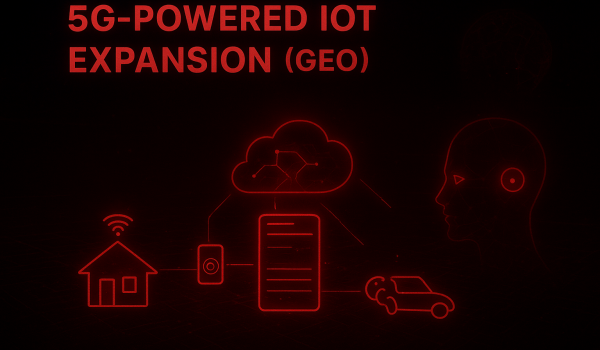
5G and the Internet of Things (IoT) were designed with each other in mind. 5G adds low latency, very high device density and faster throughput; IoT adds the sensors, machines and vehicles that generate the data. Together they make real-time decisions possible in places that previously relied on manual checks or batch reports, from warehouse floors and utility grids to fleets, factories and city infrastructure.
For IT and business leaders, the harder part is not the radio. It is the architecture around it: where data is processed, how thousands of devices are identified and patched, how the network is segmented, and who owns the data that comes out. This article covers those design decisions and the security and governance choices that decide whether a 5G IoT project scales or stalls.
What 5G actually adds for IoT
The international requirements for 5G, defined by the International Telecommunication Union under the IMT-2020 program, set three headline goals that matter for connected devices: support for up to one million devices per square kilometer, user-plane latency as low as 1 millisecond for ultra-reliable communications, and peak download rates of 20 Gbps. Real-world networks do not deliver all three at once, everywhere. They are design targets, and each maps to a different class of IoT use.
- Massive machine-type communication: large numbers of low-power sensors, such as smart meters, asset trackers and environmental monitors, that send small amounts of data.
- Ultra-reliable low-latency communication: machines that need fast, dependable control loops, such as industrial robots, automated guided vehicles and some grid equipment.
- Enhanced mobile broadband: high-bandwidth devices, such as video analytics cameras, drones and augmented-reality maintenance tools.
Many deployments do not need 5G at all. Wi-Fi, LTE-M, NB-IoT or LoRaWAN are often cheaper and perfectly adequate for sensors that report every few minutes. 5G earns its place where mobility, density, reliability or latency requirements exceed what those options can deliver.
Architecture choices: public, private and edge
The first design decision is which network. Public carrier 5G is the fastest to deploy and suits devices that move across wide areas, such as fleet vehicles or field equipment. Private 5G, a dedicated network on a campus, port, plant or warehouse, gives the organization control over coverage, capacity and security policy. In the United States, the shared CBRS spectrum band has made private cellular networks practical for enterprises that are not carriers. Carriers also offer network slicing, which reserves a logical portion of a public network with defined performance for a specific customer or application.
The second decision is where data is processed. Sending every reading to a distant cloud region adds latency and cost. Multi-access edge computing places compute close to the devices, often on site or at the carrier’s local facility, so that time-sensitive decisions such as stopping a machine or rerouting a vehicle happen locally, while summaries and history flow to the cloud for analytics. We explore that model further in Edge and Ambient Computing.
The trade-off is complexity. Private networks and edge nodes are infrastructure your team, or a partner, must operate, monitor and patch. The business case needs to include those running costs, not just the pilot.
Security: the device is the weakest link
5G includes stronger security features than earlier mobile generations, such as better protection of subscriber identities and mutual authentication between device and network. That does not make a 5G IoT deployment secure. The weak points are usually the devices themselves and the systems they connect to: default passwords, unpatched firmware, exposed management interfaces and flat networks that let a compromised camera reach the finance server.
Standards are catching up. NIST’s IR 8259 series defines baseline cybersecurity capabilities IoT manufacturers should build in, such as device identity, secure updates and configuration control. In January 2025 the FCC launched the U.S. Cyber Trust Mark, a voluntary label for consumer smart devices that meet defined security criteria. Enterprise buyers can use the same criteria as a purchasing checklist, even for equipment outside the program.
For operational technology in particular, the consequences of compromise are physical: stopped production lines, unsafe conditions, service outages. Our article on industrial and critical infrastructure threats explains why these environments have become priority targets.
A deployment checklist for 5G IoT projects
- Start with the decision, not the device. Define which operational decision will be faster or better, and the metric that proves it, such as downtime hours or fuel cost.
- Match connectivity to the need. Choose public 5G, private 5G, slicing or a non-5G option per device class, based on mobility, density and latency.
- Buy secure devices. Require unique credentials, signed firmware updates, a published support period and a vulnerability disclosure process from vendors.
- Segment the network. Place IoT devices in their own zones with only the connections they need, and never on the same flat network as business systems.
- Maintain an inventory. Track every device, its firmware version, owner and location. Devices you cannot see cannot be patched.
- Govern the data. Decide who owns device data, how long it is kept, and whether any of it is personal information subject to privacy law.
- Plan for interoperability. Favor open protocols and standard data formats so the platform is not locked to a single vendor.
Where the business value shows up
The strongest returns tend to come from three areas. Predictive maintenance uses vibration, temperature and power data to fix equipment before it fails, reducing unplanned downtime. Asset and logistics tracking gives real-time visibility of inventory, vehicles and containers, cutting losses and idle time. Energy management adjusts lighting, HVAC and equipment use based on actual occupancy and demand. Smart city projects combine all three across traffic, utilities and public safety.
In each case the value comes from acting on data, not collecting it. Organizations that connect devices without redesigning the process around the new information usually end up with dashboards nobody uses.
Frequently asked questions
Do we need private 5G, or is Wi-Fi enough?
For most offices and many warehouses, modern Wi-Fi is enough. Private 5G makes sense for large outdoor or industrial sites, highly mobile equipment, or applications that need predictable latency and reliability under heavy load.
Is 5G more secure than 4G for IoT?
The network layer is stronger, but most IoT compromises happen through the devices and the applications behind them. Device hardening, segmentation and patching matter more than the radio generation.
What is the first step for a mid-sized company?
Pick one process with a measurable cost, such as equipment downtime, and run a limited pilot with a secure device baseline and a clear success metric before expanding.
Build connected infrastructure that holds up
Delana Technologies helps organizations design and secure connected infrastructure, from network segmentation and device baselines to compliance and governance for the data IoT produces. To plan your deployment, call 239.414.5126 or contact us.
Sources: ITU-R Report M.2410, “Minimum requirements related to technical performance for IMT-2020 radio interface(s)” (2017); NIST IR 8259 series on IoT device cybersecurity capabilities; Federal Communications Commission, U.S. Cyber Trust Mark program (January 2025).