

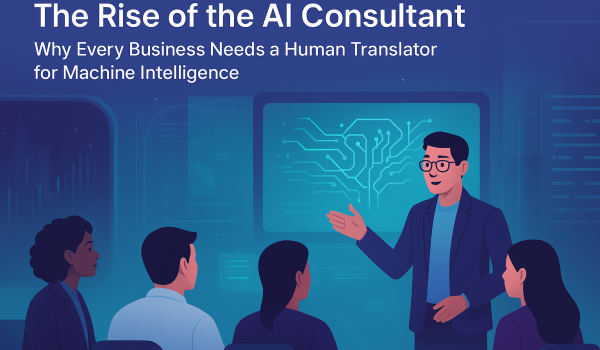
Almost every organization now wants to use AI. Far fewer know where it will actually pay off, what it will cost to run, how to keep customer data safe while using it, or how to bring their people along. The AI consultant exists to answer those questions: a translator between what the technology can do and what the business needs, who turns a vague ambition into a short list of projects worth funding.
AI is not a plug-and-play product. It does not optimize operations or double returns on its own, and without strategy it is just another software subscription. But the AI consulting market has filled up quickly, and the quality varies widely. This article explains what a good AI consulting engagement looks like, the three questions it should answer, and how to tell a real advisor from a reseller with a slide deck.
The three questions every leader is asking
Conversations about AI in most businesses come down to three questions. A useful consultant helps you answer all three, not just the first.
How do we actually use AI to grow or run the business better? This means identifying specific workflows where AI can save time, reduce errors or create revenue, such as customer support triage, sales research, document review, forecasting or fraud detection, and estimating the value of each one honestly.
How do we protect our data and customers while doing it? This covers which tools are approved, what data can be shared with them, how outputs are checked, and which regulations apply. Employees are often already using public AI tools without guidance, a problem we covered in Shadow AI in 2026.
How do we prepare our people? AI changes how jobs are done. The goal is to redesign roles so people spend less time on repetitive work and more on judgment and relationships, which requires training, clear expectations and honest communication about what will change.
What a good engagement looks like
Engagements vary in size, but strong ones follow a recognizable sequence and produce concrete deliverables at each step:
- Discovery. Interviews with leaders and front-line staff, a review of current systems and data, and an inventory of AI tools already in use. Deliverable: a current-state assessment.
- Use-case prioritization. A ranked list of opportunities scored on value, feasibility, data readiness and risk. Deliverable: a short list of two or three pilots with expected benefits and costs.
- Governance foundations. An acceptable-use policy, data classification rules for AI, vendor review criteria and an owner for AI risk. Deliverable: policies people can actually follow.
- Pilot delivery. A time-boxed build with a clear success metric agreed in advance. Deliverable: a working pilot and a measured result.
- Scale or stop. An honest decision based on the pilot’s results, with a plan for production, monitoring, training and ongoing cost. Deliverable: a roadmap, or a documented reason to stop.
The “stop” option matters. Many AI pilots never reach production or never recover their costs, which we examined in AI cost overruns in 2026. A consultant who has never recommended stopping a project is not giving you independent advice.
Governance is part of the job, not an add-on
Responsible AI use is increasingly a legal and contractual matter, not just an ethical one. Useful reference points include the NIST AI Risk Management Framework, published in January 2023, which gives a voluntary structure for identifying and managing AI risks; ISO/IEC 42001, the international standard for AI management systems published in December 2023; and the EU AI Act, which entered into force on August 1, 2024 and applies in phases to organizations whose AI systems reach the EU market.
Most small and mid-sized US businesses will not need full certification against any of these. But customers, insurers and auditors are starting to ask how AI is governed, and a consultant should be able to map your use cases to the obligations that apply, including sector rules in healthcare, finance and legal services, and existing privacy laws. Governance should also be proportionate. A marketing team drafting social posts with AI needs a light policy; an AI system that screens loan applicants or summarizes patient records needs documented testing, human review and a clear owner.
How to choose an AI consultant
These questions separate experienced advisors from the rest:
- Are you independent of vendors? Ask whether they earn referral fees or resale margins from the tools they recommend.
- What have you put into production? Ask for examples of systems still running a year later, with measured outcomes, not just demos.
- How do you handle security and data protection? A good answer covers data flows, access control, vendor terms on training with your data, and logging.
- How will we measure success? Look for specific metrics agreed before work begins, such as hours saved, error rates or response times.
- What happens after you leave? Ask who will own, monitor and pay for the system, and how knowledge is transferred to your team.
Red flags include promising specific ROI before seeing your data, recommending a platform before understanding your problems, and treating security and training as optional extras.
People, not just technology
The organizations getting the most from AI are the ones combining human judgment with machine speed. A common phrase captures the competitive reality: AI will not replace most workers, but people who use AI well may outperform those who do not. A consultant’s job includes helping staff learn to work with AI tools, adjusting processes so AI output is checked where it matters, and making sure managers can explain what is changing and why. We explored that theme in why the AI consultant is the missing piece in your AI strategy.
Frequently asked questions
How long does an AI consulting engagement take?
A focused assessment and prioritization for a small or mid-sized business can take a few weeks. Pilots typically run one to three months. Larger programs continue in phases, with a decision point after each one.
Should we start with tools or with strategy?
Strategy, briefly. A short prioritization exercise prevents buying tools that solve the wrong problem. That said, strategy should lead quickly to a small, measurable pilot rather than a long report.
What is the difference between an AI consultant and an AI engineer?
An AI consultant focuses on which problems to solve, how to govern AI, and how to change processes and roles. An AI engineer builds and operates the systems. Many engagements need both, and good consultants either have engineering depth or work closely with engineers.
Connect AI ambition to business value
Delana Technologies provides vendor-independent AI strategy, governance and implementation, with security built in from the start. Learn about our AI consulting and agentic AI solutions, call 239.414.5126 or contact us.
Sources: NIST AI Risk Management Framework 1.0 (January 2023); ISO/IEC 42001:2023, Artificial intelligence management system; European Commission, EU AI Act entry into force (August 1, 2024).