

August 2026 was not a quiet month. Eleven frontier and near-frontier models shipped in thirty-one days, inference prices kept sliding, the average enterprise nearly tripled the number of AI agents it runs, and Washington moved on AI policy faster than at any point in the previous two years. If you stepped away for the summer, here is what changed — and why it matters.
1. The release cadence has gone from quarterly to weekly
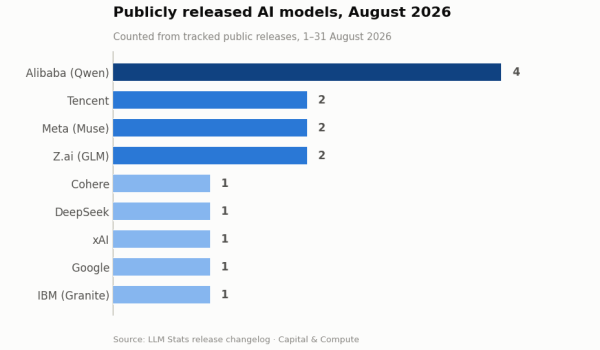
The single clearest signal of where AI sits in 2026 is the sheer rate of shipping. Model releases used to be tentpole events spaced months apart. In August alone, at least eleven models landed from nine different organizations.
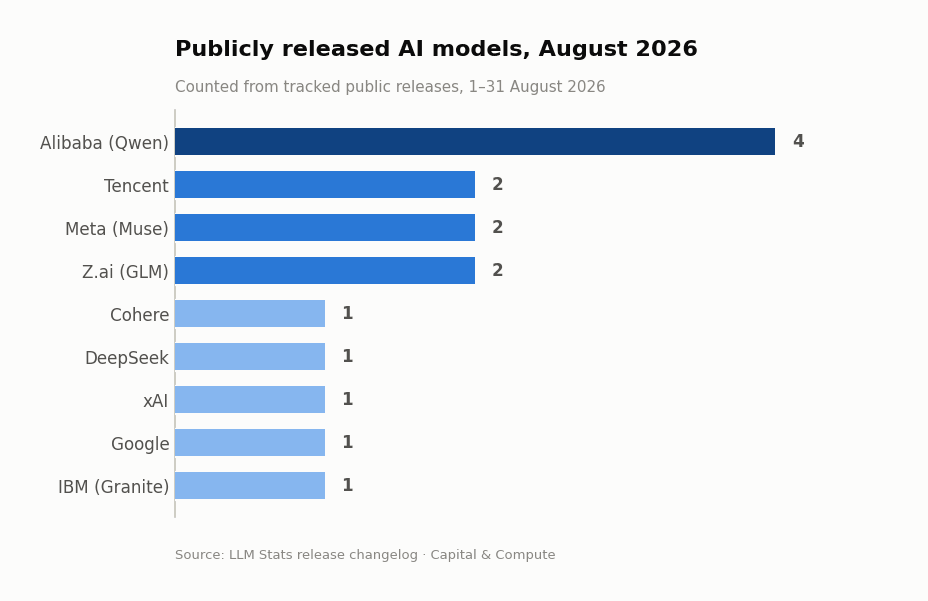
Alibaba’s Qwen team led with four releases, including Qwen3.8-Max (a 2.4-trillion-parameter mixture-of-experts model with 262K native context and open weights) and Qwen3.8-Flash-Next, billed as a preview of the Qwen4 architecture. Z.ai, Meta and Tencent each shipped two.
The headline names were quieter. OpenAI released no new model in August, instead making GPT-5.6 Sol the default for Plus and Pro users and Luna for Free and Go tiers. Anthropic’s newest remains Claude Opus 5 from July. Google shipped Gemini 3.7 Flash; xAI shipped Grok 4.6.
Capabilities that seemed cutting-edge months ago are now baseline expectations.
LLM Stats, tracking 368+ model releases across 59+ organizations
2. The price war is the real story
Raw capability is no longer the axis most buyers are competing on — cost per token is. And the spread between the cheapest and most expensive credible option is now more than an order of magnitude.
| Model | Input | Output | Note |
|---|---|---|---|
| GLM-5.3-Flash (Z.ai) | $0.15 | $0.50 | 320B/18B MoE, MIT-licensed |
| Gemini 3.7 Flash (Google) | $0.75 | $3.75 | Introductory rate; doubles 1 Jan 2027 |
| GLM-5.3 (Z.ai) | $1.40 | $4.40 | Enhanced post-training on GLM-5.2 base |
| Grok 4.6 (xAI) | $2.00 | $6.00 | Cached input rose $0.30 → $0.50 |
| Claude Sonnet 5 (Anthropic) | $2.00 | $10.00 | September price increase cancelled |
Two details in that table matter more than the headline numbers. Google’s Gemini 3.7 Flash rate is introductory — it doubles to $1.50/$7.50 on 1 January 2027. And Grok 4.6 held its headline pricing while quietly raising cached input from $0.30 to $0.50 per million tokens, which meaningfully increases real cost for cached-prompt workloads. Read the fine print before you budget.
Anthropic moved the other way, cancelling a scheduled September increase and fixing Claude Sonnet 5 at $2/$10 permanently.
3. Agents stopped being a pilot and became infrastructure
The most consequential enterprise number of the year: the average organization ran 5 AI agents in early 2025. By April 2026 that figure was 13. Agents crossed the line from experiment to standing infrastructure in roughly fifteen months.
Spending is following, but unevenly. The top 1% of US businesses now spend around $7,400 per employee on AI; the median is $11.95. That is not a gap, it is a chasm — and it is the single best predictor of who will look untouchable in three years.
Governance is consolidating too. Google moved the A2A (Agent-to-Agent) Protocol to the neutral Agentic AI Foundation, now over 250 members. Agent interoperability is being standardized in the open rather than owned by one vendor — a meaningful signal for anyone worried about lock-in.
4. Open weights closed the gap
August’s open-weight releases were not consolation prizes. Meta’s Muse Glimmer is a 29.6B multimodal model under Apache 2.0 that runs on a single GPU. IBM shipped Granite 4.2 open source in 3B, 8B and 30B sizes. Z.ai’s GLM-5.3-Flash is MIT-licensed at $0.15 per million input tokens.
The competitive picture shifted with it: xAI and Meta are closing the performance gap with OpenAI and Anthropic, while DeepSeek runs a premium tier alongside genuinely cheap options. For most businesses the practical consequence is simple — the model layer is commoditizing, and your advantage has to live somewhere else.
5. US policy moved fast this summer
After two years of talk, the regulatory picture changed materially in July and August.
| Date | Action | Why it matters |
|---|---|---|
| Jul 1 | FTC proposes using Section 5 deception authority against undisclosed AI output steering | Companies violate law when they steer AI outputs toward undisclosed objectives |
| Jul 1 | Colorado H.B. 26-1263 signed | First chatbot-specific law; bans emotional-dependency design, adds parental controls (effective Jan 2027) |
| Jul 6 | Illinois S.B. 315 signed | First state to require annual third-party safety audits of frontier models from developers over $500M revenue; 72-hour incident reporting |
| Jul 14 | GOLD EAGLE Initiative launched | Treasury, DHS and DoD partner with AI developers on critical-infrastructure vulnerability detection |
| Jul 22 | Genesis Mission funded | 15+ federal agencies commit $5B+ across health, infrastructure, industrial competitiveness and scientific discovery |
| Aug 4 | White House convenes AI firms on advanced model safety | Signals federal attention to frontier-model risk thresholds |
Meanwhile the GAAIA discussion draft — a 270-page framework from Representatives Obernolte and Trahan proposing three-year state preemption plus transparency and audit mandates — remains stalled. The practical effect: state law is where the binding rules are being written right now, and they do not agree with each other.
6. The public mood is getting worse, not better
52% of Americans are now more concerned than excited about AI. For comparison, only 18% described themselves as excited back in 2021. Whatever the capability curve looks like, the trust curve is pointing the other way.
There is a concrete economic driver behind some of that. French regulators estimate AI summaries have cut publisher traffic by 33% to 38% — a direct, measurable transfer of value away from the people producing the underlying content.
Industry responses are emerging. Anthropic added invisible statistical watermarking to generated text for compliance purposes. OpenAI is testing Private Safety Processing for zero-retention enterprise deployments. The IAB updated its AI Disclosure Framework to cover Europe, Asia, New York and California requirements. And notably, OpenAI slowed development of Astra, citing cybersecurity concerns and potential misalignment — a rare public instance of a lab applying its own brakes.
What to actually do about it
- Re-price your AI stack this quarter. If you set your budget on 2025 rates you are almost certainly overpaying. Check cached-input pricing specifically — that is where increases are hiding.
- Watch the 1 January 2027 cliff. Gemini 3.7 Flash doubles then. Any workload you build on introductory pricing needs a migration plan or a renegotiation date in the calendar.
- Treat agents as infrastructure, not experiments. Thirteen agents per organization means monitoring, access control, audit logging and failure handling — the same discipline you would apply to any production system.
- Assume state-level compliance obligations. With federal preemption stalled, Illinois and Colorado are the template. If you deploy chatbots or frontier models, map your obligations by state now.
- Evaluate open weights seriously. A 29.6B Apache-2.0 model on a single GPU changes the build-versus-buy calculation for anything involving sensitive data.
- Disclose your AI use. The FTC has signalled that undisclosed output steering is a deception issue, and public sentiment is not on your side. Get ahead of it.
Frequently asked questions
What was the biggest AI development in August 2026?
There was no single breakthrough. The defining feature of the month was velocity — eleven models from nine organizations in thirty-one days, with the competitive pressure showing up in pricing rather than in capability jumps.
Which AI model is cheapest right now?
Of the widely available options, Z.ai’s GLM-5.3-Flash is the cheapest at $0.15 per million input tokens and $0.50 per million output tokens, and it is MIT-licensed. Google’s Gemini 3.7 Flash is cheaper than most frontier alternatives at $0.75/$3.75, but that is an introductory rate that doubles on 1 January 2027.
How many AI agents does a typical enterprise run?
Around 13 as of April 2026, up from about 5 in early 2025.
Is AI regulated in the United States yet?
Not comprehensively at the federal level — the GAAIA framework remains stalled in Congress. But binding state law now exists: Illinois S.B. 315 requires third-party safety audits of frontier models, and Colorado H.B. 26-1263 regulates chatbots specifically. The FTC has also signalled it will treat undisclosed AI output steering as deception under Section 5.
Sources: MarketingProfs AI Update (21 August 2026); LLM Stats release changelog; Capital & Compute, “New AI Models Released in August 2026”; Mintz, “AI: The Washington Report,” August 2026 edition; Artificial Intelligence News.