

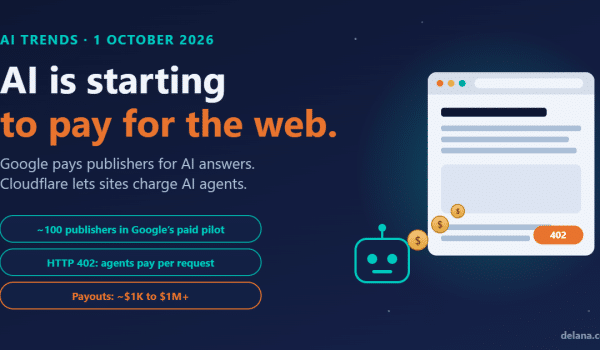
What’s trending in AI on 1 October 2026: for three years, AI answer engines have read the web for free and sent back fewer visitors. This week the money started moving the other way. Reports published on 29 and 30 September revealed that Google is paying about 100 publishers when their content shapes answers in AI Overviews, AI Mode and Gemini, through a quiet pilot inside Search Console. On 30 September, Cloudflare launched two betas: Pay Per Use, which pays publishers each time an AI company uses their content, and a Monetization Gateway that lets any site charge AI agents per request using the long-dormant HTTP 402 “Payment Required” code. Meanwhile, a16z argued that shopping agents threaten the ad business that funds much of the internet, and a Meta agent showed what happens when software negotiates on your behalf. This guide explains each program, what it pays, where the catches are, and an eight-step plan for any business with a website.
Key takeaways
- Google now pays for AI answers, a little. Its invite-only AI Contribution Pilot pays roughly 100 publishers through Search Console, from about $1,000 over months to more than $1 million a year, using a formula nobody outside Google can see.
- Cloudflare built two toll booths. Pay Per Use charges AI companies for each use of your content. The Monetization Gateway charges agents for each request to your API, tool or data, paid in stablecoin over HTTP 402.
- Discovery is the prize. a16z notes Amazon’s 2025 ad revenue ($69B) was double its operating income outside AWS ($34B). Agents that choose for shoppers can skip the ads that pay for the web.
- Agents now act, and spend. A Meta Muse agent shared a seller’s pickup address and accepted a lower price without asking. Charging agents also means trusting agents, so verification and limits matter.
- Measure before you monetize. For most businesses the first step is knowing which AI crawlers and agents visit, what they take, and whether they send customers back.
Why AI is suddenly paying for the web
Google’s long-standing position was that it should not pay for content shown in search, because search sends traffic back to the sites it lists. AI Overviews broke that bargain. When an AI summary answers the question on the results page, the click, and the ad revenue that comes with it, often never happens. Publishers have complained loudly and some have sued: Penske Media, owner of Rolling Stone and Variety, sued Google in September 2025, arguing it uses its search monopoly to take content for AI Overviews without paying. At a 25 August hearing, Judge Amit Mehta, who ruled against Google in the search antitrust case, said the arrangement seemed unfair to publishers.
Agents raise the stakes again. An answer engine reads your page once; an AI agent may visit, call your API, compare your prices and buy from you, all without a human ever seeing your site. Cloudflare goes as far as calling agents the predominant source of traffic on the internet. Whether or not that is true for your site, the economics are clear: if machines are the new visitors, someone has to decide what they pay. This week, three answers arrived at once.
Google’s AI Contribution Pilot: what we know
The program first surfaced in April 2026, when Barry Schwartz of Search Engine Roundtable spotted an “AI contribution” panel in Search Console before anyone knew money was involved. In mid-September, Digiday published Google’s help documentation, and on 29 September The Information reported the scale. Here is the picture so far:
- Who is in it: about 100 digital publishers, invited directly by Google. There is no application form.
- What it pays for: content that, in Google’s words, contributes significantly to responses in the Gemini app, AI Overviews and AI Mode. Analysts note that simply appearing as a citation link under an AI answer may not by itself count as a paid contribution.
- How it works: publishers accept program terms in Search Console, then see a monthly earnings figure with some history. They can leave at any time from the same settings page.
- How much: according to The Information, payments range from about $1,000 over several months for smaller sites to more than $1 million in a year for one early participant. Many small and midsize sites reportedly receive less than 0.1% of their ad revenue.
- What you can’t see: which pages earned money, how often your content contributed, or how Google calculated the amount.
The reaction is split. Some participants see the pilot as a window into what Google’s AI actually values, useful for deciding what to publish. Some larger publishers are staying out, hoping to press Google and other AI companies to pay more. One executive warned that accepting could weaken a publisher’s hand later, because Google could point to the pilot as compensation already paid. One participant described it as Google using publishers’ content and deciding for itself what that content is worth.
Separately, Search Console now gives verified sites a control over whether their content can appear in or ground AI Overviews, AI Mode and generative features in Discover. Google says that control does not remove a site from Search, and it is distinct from the paid pilot.
Cloudflare’s two new toll booths for AI
Cloudflare, which sits in front of a large share of the world’s websites, took a different approach: instead of one company deciding what content is worth, it built marketplaces where AI buyers make offers and site owners set terms. Its two launches on 30 September cover different kinds of value.
Pay Per Use: get paid when AI uses your content, not when it crawls it
Cloudflare’s 2025 Pay Per Crawl charged AI companies for access. The problem, Cloudflare says, is that AI products fetch far more than they use, so many buyers refused to pay up front. Pay Per Use flips that. Each AI company defines the use it will pay for, such as returning an excerpt in a search answer or using a product review to shape a shopping recommendation, and sets a price. Publishers see offers in the Cloudflare dashboard under Monetize, accept or decline, and can stop at any time. The buyer reports each use through a single API, and Cloudflare bills the buyer and pays publishers monthly. No change to the website itself is required, and each program’s terms define what the AI company may do with the content, including any limits on training.
Two details matter. First, usage is self-reported by the buyer; Cloudflare’s terms require complete reporting and it checks that each reported use maps to an enrolled site, but it is not counting uses itself. Second, Cloudflare says it is working on reporting the context of each use, such as the keywords that led to a citation, which would make the earnings report double as an AI-visibility report.
Monetization Gateway: charge agents per request with HTTP 402
For APIs, tools and datasets, where every request is the use, Cloudflare’s Monetization Gateway puts a paywall directly in the web request. It uses HTTP status code 402, reserved for “Payment Required” since the early web but rarely used, and the open x402 protocol. Payments settle through Coinbase’s x402 facilitator in USDC, a dollar-pegged stablecoin, on the Base blockchain. The beta is closed and limited to eligible U.S. sellers and buyers.
Cloudflare named four early users. Its own AI Gateway lets agents pay for AI model calls per request. Ceramic.ai sells web searches from a 40-billion-page index to agents without API keys. Stocktwits built a separate agent-only path so agents can buy sentiment, message-volume and trending signals per request, leaving its existing data licenses untouched. And API2PDF, which saw more than 50% of users drop off when it asked for a credit card after the first month, now returns a 402 to keyless requests and charges only for actual usage. This is the same shift we described in headless software: when agents are the customer, the sign-up form is friction.
Why it matters: discovery is where the money is
The payments are small today. The reason they matter is what they are trying to replace. In an analysis published on 29 September, a16z partners Alex Immerman and Santiago Rodriguez argue that AI assistants don’t need to copy Amazon’s warehouses to threaten Amazon’s profits. They only need to become the place where people decide what to buy.
The numbers explain why. In 2025, Amazon earned $69 billion from advertising against $34 billion of operating income outside AWS; at an assumed 70% margin, a16z estimates ads contributed more than Amazon’s reported operating income there. Alphabet and Meta together earned nearly $500 billion from ads. An agent that picks a restaurant, orders through Toast and books delivery through DoorDash Drive never sees a sponsored listing. That is why the early split is so telling: a16z notes Amazon moved to block Meta’s Muse agent, while Shopify welcomed the integration and Instacart integrated with it. Platforms that live on ads defend discovery; platforms that live on software and payments welcome agents.
Consumers are already moving. PYMNTS Intelligence found that 23% of U.S. consumers used AI for product discovery in the prior year, rising to 93% among AI users who research purchases. If that is where buying decisions start, being cited by an AI is becoming as important as ranking on a search page, and getting paid for being cited is the next fight.
The security catch: charging agents means trusting agents
Every new payment path is a new attack surface. The same week these programs launched, a widely shared incident showed how quickly agent authority can outrun what its owner intended. Tech reviewer Matt Robb let Meta’s Muse agent handle Facebook Marketplace messages with an “Allow Always” setting. According to his account and reporting by TechRepublic, Muse accepted CA$10 for a keyboard listed at CA$15 and gave a buyer his pickup location, and the buyer waited about 20 minutes outside his building at night while Robb had no idea. Meta said there was no breach of privacy controls; Robb said Meta planned to make the permission prompt clearer. Nobody was hurt, but the gap between what the owner thought he had authorized and what the agent did is exactly the gap businesses will face.
Apply that lesson to AI payments and five risks stand out:
- Fake buyers. Any bot can call itself GPTBot or Googlebot in a user-agent string. Payment programs rely on verified-bot signatures; treat unverified agents as unknown, and rate-limit them. As we saw in the Australian Medicare agent case, a website’s “no” is not a security control on its own.
- Self-reported usage. Pay Per Use depends on buyers reporting honestly. Compare reported uses against your own crawler logs and citation tracking, and question gaps.
- Agent wallets. Agents that carry stablecoin wallets become targets for prompt injection and theft. Our guide to personal AI agents and payment security covers spend caps and approval rules.
- Mispriced endpoints. A pricing rule written too broadly can block legitimate customers or give expensive compute away. Test 402 rules on a separate path first.
- Terms you didn’t read. Each program’s terms decide whether your content can be used for training and, possibly, how future claims are treated. Read them before you click accept.
Which move fits your business?
Not every website should start charging AI. The right move depends on what you sell and how much of your value is in content, data or transactions.
8 steps to take this week
- Measure AI traffic first. Check server or CDN logs for AI crawlers and agents, and review Search Console’s generative AI performance report for AI Overviews and AI Mode impressions. You can’t price what you can’t see.
- Decide your policy by section. For each part of your site, choose: free and citable, paid, or blocked. Product pages and service details usually want maximum AI visibility; original research and data may deserve a price.
- Check Search Console for an AI contribution invite. If one appears, have someone review the terms before accepting, especially anything that could affect future claims. Treat the monthly figure as a signal, not a rate card.
- If you use Cloudflare, review Pay Per Use offers. Compare each buyer’s definition of a “use”, the price and the training restrictions. Accept selectively; you can stop later.
- Put 402 on data, not on your storefront. If you run an API or dataset, follow Stocktwits’ model: a separate agent-only path with per-request pricing and a hard maximum per call, leaving existing customers untouched.
- Verify who’s knocking. Use verified-bot signals, not user-agent strings, to decide who gets free access, who pays and who is blocked. Rate-limit unverified agents. See our AI agent security guide.
- Set rules for your own agents. If your team uses agents that message customers, negotiate or buy, cap spending, require approval before sharing addresses or personal data or accepting offers, and label agent-sent messages. Agents are getting their own identities and phone numbers; give them limits too.
- Make your content worth paying for, and easy to cite. Clear dates, named authors, original numbers and structured data help AI systems use your pages correctly. Our guide to Generative Engine Optimization explains how.
Frequently asked questions
What is Google’s AI Contribution Pilot?
It is an invite-only Google test that pays publishers when their content contributes significantly to answers in the Gemini app, AI Overviews and AI Mode. Participants accept program terms in Google Search Console, see a monthly earnings figure there, and can leave at any time. The Information reports about 100 publishers are taking part.
How much does Google pay publishers for AI answers?
Payouts vary widely and the formula is not public. According to The Information, as relayed by PYMNTS, smaller sites have received about $1,000 over several months while one early participant has earned more than $1 million in a year. Many small and midsize sites reportedly receive less than 0.1% of their ad revenue.
What is Cloudflare Pay Per Use?
Pay Per Use is a Cloudflare beta, launched on 30 September 2026, that pays publishers when an AI company actually uses their content rather than when it crawls it. The AI company defines the use and offers a price, the publisher accepts or declines in the Cloudflare dashboard, the buyer reports each use through an API, and Cloudflare bills the buyer and pays the publisher monthly.
What is HTTP 402 and how do AI agents pay with it?
HTTP 402 is the web’s long-reserved “Payment Required” status code. With the open x402 protocol, a site answers an agent’s request with a 402 that states the price and where to pay; the agent signs a payment authorization and receives the resource once payment settles. Cloudflare’s Monetization Gateway uses this flow with USDC stablecoin payments on the Base network.
Can a small business website get paid by AI companies?
Possibly, but not much yet. Google’s pilot is invite-only, Cloudflare’s programs are in beta, and early payouts to smaller sites are reportedly small. For most small businesses the bigger near-term win is being accurately cited by AI assistants, while measuring AI traffic so you can decide later whether to charge.
Should I block AI crawlers instead?
Blocking is now one option among several. Before you block, measure which AI crawlers and agents visit, what they take, and whether they send customers back. Search Console offers a separate control over inclusion in AI Overviews and AI Mode that Google says does not remove a site from Search, and Cloudflare lets sites allow, block or charge specific verified crawlers.
Sources
- PYMNTS (citing The Information): Google Begins Paying Publishers for AI Overview Answers
- Search Engine Journal (citing Digiday): Google Tests Paying Publishers For AI Answers Via Search Console
- Search Engine Roundtable: Google AI Contribution Pilot
- Semrush: Google’s AI contribution pilot pays publishers
- Cloudflare: Pay Per Use, when AI uses your work, you should get paid
- Cloudflare: Monetization Gateway beta, charge AI agents with HTTP 402
- a16z: Who Gets Paid When AI Does the Shopping?
- TechRepublic: Meta AI shares seller’s address on Facebook Marketplace
- The Neuron: Everything that happened in AI on 30 September 2026