

Published 24 September 2026
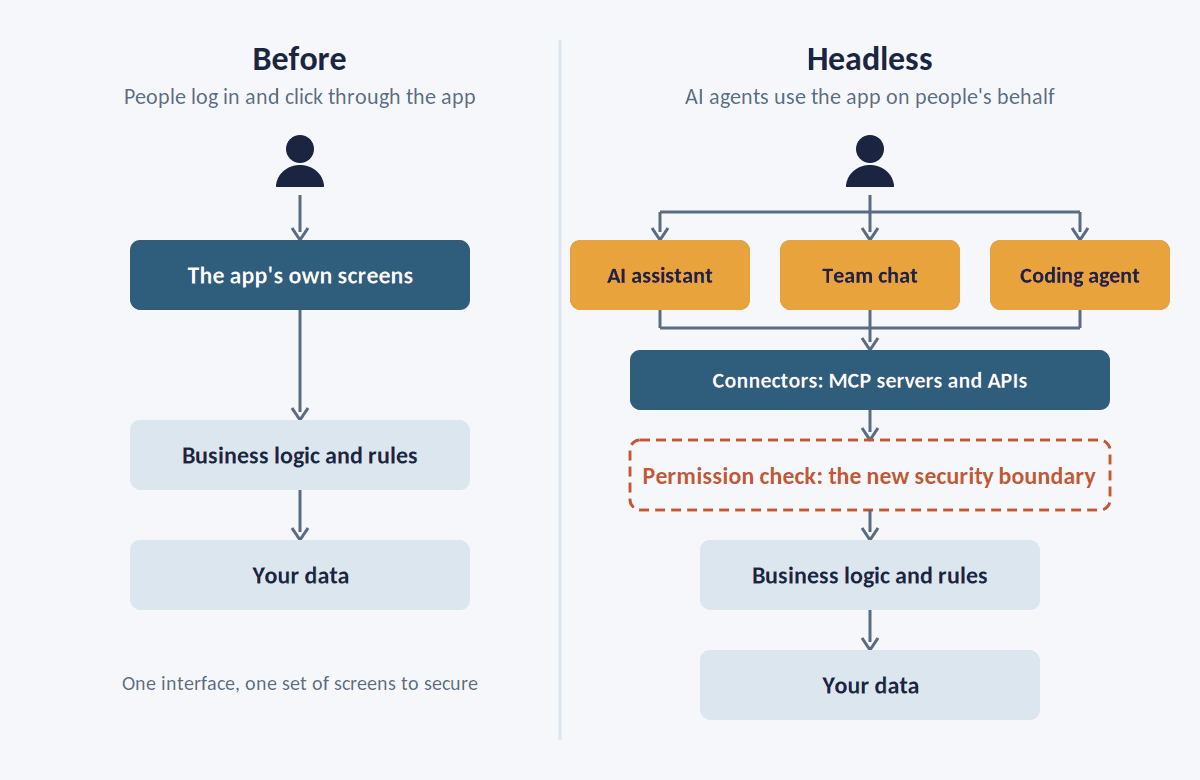
The short answer: the AI trend reshaping business software this month is not a new model. It is the disappearance of the app screen. At Dreamforce 2026 (15–17 September, San Francisco), Salesforce’s headline message was that AI replaces the UI. Its new AIforce layer carries Salesforce data, business logic and permissions into Claude, Slack and other AI interfaces, running on Headless 360, which exposes the platform as APIs, MCP tools and command-line commands. Salesforce is the loudest example of a wider shift toward headless software, where AI agents, not people, become the main users of business apps.
For businesses, the upside is less clicking, fewer tools to learn and faster answers. The catch is that every permission nobody cleaned up is now reachable by software that works at machine speed, and the way you pay for software is about to change. Here is what happened, why it matters, and a seven-step checklist to get ready.
Key takeaways
- Headless software separates an application’s data and business rules from its screens, so any AI agent can use it through connectors such as MCP servers and APIs.
- Salesforce unveiled AIforce on 15 September as an interface layer on top of Data 360, Customer 360 and Agentforce. Its Headless 360 MCP server is in open beta, the Data 360 MCP server is generally available, and Salesforce says they serve agents in Agentforce, Claude, ChatGPT, Cursor and others.
- Salesforce says every agent request runs on the person’s existing permissions and business rules. That makes your access model the security boundary for every new AI surface.
- Per-seat pricing assumes a human logs in. As agents do more of the work, expect vendors to move toward usage and agent-based pricing, and prepare for that at renewal.
- Not every vendor is opening up. Some are restricting outside agents to protect their position, so your options will depend on who controls the interface.
What “headless” software means
For two decades, business software has come as a bundle: your data, the rules that govern it, and the screens people click through to use it. Dashboards, record pages and report builders were the product. Headless software pulls those layers apart. The data and business logic stay where they are, but the “head”, the vendor’s own interface, becomes optional. Instead, capabilities are exposed so that other tools can call them directly.
In 2026 the tool doing the calling is increasingly an AI agent. A sales manager asks an assistant in Slack or Claude which deals are at risk this quarter, and the agent queries the CRM, applies the company’s pipeline rules and answers, without anyone opening the CRM. The common plug is the Model Context Protocol (MCP), an open standard that lets an agent discover and use tools across many systems. The protocol is still maturing: its specification dated 28 July 2026 moved toward a stateless core and added changes aimed at authorization and enterprise deployment.
What Salesforce actually announced
Dreamforce produced roughly a dozen announcements, and several had been released earlier and simply demonstrated on stage. These are the ones that change how businesses use the platform.
| Announcement | What it is | Status |
|---|---|---|
| AIforce | An interface layer that brings the context of Data 360, the application logic of Customer 360, and Agentforce into any AI interface, including Claude, Slack and the Lightning search bar. | Unveiled 15 September 2026 at the Dreamforce keynote |
| Headless 360 | Salesforce capabilities exposed as APIs, MCP tools and command-line commands so outside agents can use them directly. Introduced in April under the line “No Browser Required” and expanded in August. | Headless 360 MCP server in open beta; Data 360 MCP server generally available |
| Claudeforce | A deeper integration bringing Claude’s reasoning into Salesforce and Slack. Anthropic CEO Dario Amodei joined Marc Benioff on stage. | Announced 26 August; demonstrated at Dreamforce |
| Koa | Salesforce’s first CRM reasoning model, built with NVIDIA on its open-weight Nemotron 3 Super. Salesforce says it was post-trained on synthetic data modelled on CRM work, not on customer data. | Announced at Dreamforce |
| Seven job-ready agents | Prebuilt agents for specific roles. | Six generally available; the seventh, Hunter, in pilot with general availability planned for November 2026 |
The interesting part is not any single product. According to Moor Insights & Strategy, most software vendors have shipped a handful of MCP endpoints and stopped there, while Salesforce positioned its agent harness to work alongside other companies’ harnesses rather than lock customers into its own. Put simply, Salesforce is betting that it wins by owning the business context, not the screen. Analysts at Codiot drew the practical conclusion: for the next two years, Salesforce work will be concentrated in integration rather than interface design. Not everyone on the show floor was convinced; some attendees felt the core Customer 360 applications got little airtime.
Why this is happening now
Three forces converged in 2026.
- Investors priced it in first. By mid-February, the S&P 500 Software & Services index had lost about $2 trillion from its October peak, according to Fortune reporting cited by Deployflow, as markets asked what justifies a per-seat license if agents do the work without logging in.
- Most of the interface was never used. Productiv’s 2026 State of SaaS report, as cited by MakeToCreate, found that enterprises use fewer than 40% of the features in their average SaaS application. An agent does not need the other 60% of the screens.
- Running agents got cheap. As we covered in The 90-Minute AI Price War, frontier model prices fell sharply this month, which makes it far more affordable to put an agent between your people and every app they use.
The security catch: your permission model is now the perimeter
When a person works through a screen, the interface itself acts as friction. To pull every account in a region, someone has to find the right report, run it and export it. An agent calling an API does not browse. It queries, and it can read in seconds what would take a person an afternoon.
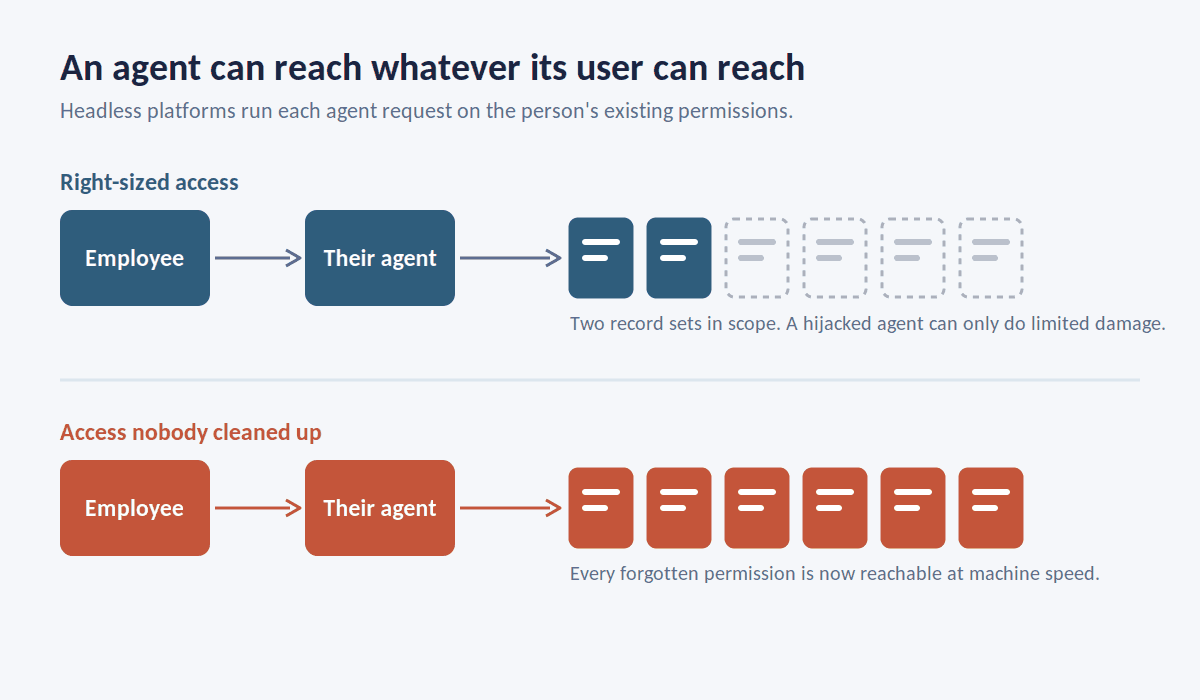
Salesforce’s design responds to this correctly: every AIforce request runs on the user’s existing permissions and business rules, so an agent only sees what the person using it can see, and Salesforce says model providers do not keep the business data used to answer questions. But that design moves the risk rather than removing it. If a sales rep still has access to every account in a territory they left two years ago, their agent has that access too. SynconAI’s architects put it plainly: AIforce makes your existing permission model the security boundary for every new surface, and the Headless 360 MCP server is an even larger surface than AIforce alone.
Five risks deserve attention before you switch agent access on:
- Inherited over-permissioning. Broad “view all” rights, shared admin accounts and access that was never removed after role changes all become agent capabilities.
- Prompt injection through your own records. An agent that reads customer emails, case notes or uploaded documents can be manipulated by instructions hidden in them. We cover the defenses in AI Agent Security in 2026.
- Connector sprawl. Every MCP server and every AI tool connected to it is a new door into your data. Employees connecting personal AI assistants to work systems is the next form of shadow AI.
- Blurry audit trails. If your logs cannot tell a person’s action from an agent acting on that person’s behalf, incident response and compliance evidence both suffer.
- Data-handling promises. “Zero data retention” is a vendor commitment for a specific path. Confirm it in writing, and check it separately for each third-party AI interface your people use.
The money catch: per-seat pricing is on borrowed time
Per-seat pricing made sense when nearly everyone used software through its interface. Integration vendor Cyclr estimates that historically around 95% of SaaS users worked through the UI and only about 5% through APIs. Headless access flips that assumption. If five people’s agents do the work that twenty people used to click through, the vendor’s seat count and your value from the product drift apart.
Vendors are already moving. Salesforce’s Agentforce shifted away from traditional seat licenses toward hybrid agent-based pricing, and Moor Insights noted after Dreamforce that it is not yet clear which pricing model will settle for agent-driven use. Expect metering by actions, credits or outcomes to spread. That can save money, or it can produce the runaway bills we described in AI Cost Overruns in 2026. Before your next renewal, ask how agent and API calls are metered, whether MCP access is included in your tier, what caps and alerts exist, and whether you can reduce seats as agent use grows.
Not everyone is taking their head off
The headless story has a counter-trend. In May, venture firm Mayfield pointed to SAP restricting external agents and consolidating its data layer as a sign of how threatened traditional software models feel when they no longer control the interface. Some vendors will open up; others will keep agents inside their own walls and charge for the privilege. Screens are not going away either. Reviewing a contract, approving a large refund or reading a forecast still benefits from a human-designed view. The likely outcome is a hybrid: agents for retrieval and routine updates, screens for review, approval and judgment.
A seven-step headless readiness checklist
- Inventory your agent doors. List which of your SaaS applications now offer MCP servers or agent APIs, and which AI tools your staff have already connected to them.
- Clean up access before you open it. Run an access review on every system you plan to expose. Remove stale permissions, shared admin accounts and broad view-all rights first.
- Start read-only. Let agents retrieve and summarize before they act. Add write actions such as updating records, sending emails or issuing credits one workflow at a time, with human approval for anything consequential.
- Approve connectors like applications. Keep an allowlist of permitted AI interfaces and MCP servers, give each one an owner, and review its scopes.
- Label agent activity in your logs. Make sure actions taken by agents are recorded as agent-initiated, tied to the human they acted for, and sent to your security monitoring.
- Test with your own messy content. Try prompt injection against real emails, tickets and notes before rollout, not after.
- Renegotiate with data. Measure how much work agents actually do, then bring usage metering, seat counts and data-retention terms to the table at renewal.
What to watch next
- When the Headless 360 MCP server moves from open beta to general availability, and what security controls ship with it.
- General availability of Salesforce’s Hunter agent, planned for November 2026.
- Whether other large platforms match with open agent access or restrict outside agents.
- How vendors meter agent consumption, and whether seat-based contracts start offering agent allowances.
- How quickly MCP authorization features mature for enterprise use.
Frequently asked questions
What is headless SaaS?
Headless SaaS is business software whose data and business rules can be used without its own interface. Capabilities are exposed through APIs and connectors such as MCP servers, so AI agents and other tools can work with the software directly.
What is Salesforce AIforce?
AIforce is the interface layer Salesforce unveiled at Dreamforce on 15 September 2026. It brings Salesforce data, logic and permissions into AI interfaces such as Claude, Slack and the Lightning search bar. Headless 360, introduced earlier in 2026, is the underlying plumbing that exposes the platform to agents.
Is headless software less secure?
Not inherently. Platforms like Salesforce run agent requests on the user’s existing permissions. The risk is that those permissions become the only boundary, so over-broad or stale access, prompt injection and unmanaged connectors matter far more than they did when people worked through screens.
Should we stop paying for software seats?
Not yet. Track how much work agents do in each application, then use that data at renewal to negotiate seat counts, agent metering and caps. Pricing models are still settling across the industry.
Sources
- Salesforce Ben: Salesforce Launches AIforce at Dreamforce ’26
- Codiot: Dreamforce 2026 Recap: What Was Announced and What It Means
- Moor Insights & Strategy: At Dreamforce 2026, Salesforce Goes All In on Agentic AI
- SynconAI: Dreamforce 2026: everything announced
- Atrium: Dreamforce 2026: The Headless Agentic Enterprise
- Deployflow: AI Agents vs SaaS: The $2 Trillion Question CTOs Must Answer
- Cyclr: SaaS Companies: Are You Losing Your Head?
- Mayfield: The Rise of Personalized and Headless Software in the AI Era
- MakeToCreate: The End of User Interfaces
- Mak It Solutions: AI Agents SaaS: How Agent-First Software Wins
Planning to connect AI agents to your CRM, help desk or ERP? Delana can run the access review, connector policy and logging setup before you switch it on. Talk to Delana.