


What’s trending in AI on 1 October 2026: the limit on AI is no longer just chips or models. It is electricity. Today the industry showed two very different answers to that problem. Above the planet, a SpaceX rocket lifted off from California carrying the first prototype satellite of Google’s Project Suncatcher, a fridge-sized spacecraft with Google’s own AI chips on board, to test whether data centers powered by near-constant sunlight could one day run in orbit. Google also published a peer-reviewed analysis of how far launch prices must fall for that to work. Down on the ground, the fight is over who pays: on 30 September the U.S. Senate blocked the Ratepayer Protection Act by 57 votes to 43, weeks after it sailed through the House 417 to 3, and NPR laid out how data-center costs are already reaching household power bills. This guide explains what launched, what it does and doesn’t prove, the cost catch, the security and data questions orbital AI raises, and seven steps for any business that runs on AI or pays an electricity bill.
Key takeaways
- Google’s AI chips are now in orbit. A Planet-built satellite carries four Google TPUs that will run AI models in 15-minute bursts, capped by heat, to see how they cope with launch stress, radiation and vacuum.
- It’s a test, not a data center. Google’s next milestone is two satellites linked by laser in 2027. Its long-range picture is a cluster of 81 satellites flying in formation.
- Launch price decides everything. Google’s own paper projects launches near $200 per kilogram around 2035, against roughly $2,700 on a Falcon 9 today. BCG puts orbital compute at about 2.5 to 3 times the cost of ground data centers now.
- On Earth, the bill has arrived. One estimate adds $168 to $216 a year to Maryland household bills, and PJM’s market monitor puts data-center costs to its 67 million customers at about $29 billion in roughly two years.
- Washington disagrees on the fix. The House-passed bill asked state regulators to consider charging big users for grid upgrades. Senate Democrats want the GRID Savings Act, which would require it.
- For your business: orbital AI changes nothing this year, but power is now part of AI pricing, cloud contracts and data-location policy.
What Google launched today
Project Suncatcher is a long-term research moonshot that Google first revealed in November 2025: could clusters of satellites, each packed with AI chips and powered by the sun, eventually do the work of a data center? Today’s launch is the first real test. The prototype rode SpaceX’s Transporter-18 rideshare mission, one of more than a hundred payloads on board, including missions from space-AI startups Satlyt and Cowboy Space Company. Satellite company Planet built the spacecraft on its standard platform.
According to NPR, the satellite carries four Tensor Processing Units (TPUs), the same family of chips Google already runs in its data centers on Earth, and will use a version of Google’s open Gemma model to answer simple queries. The chips will run for 15 minutes at a time before they have to shut down and shed heat. TechCrunch reports the spacecraft has to supply roughly a kilowatt of continuous power to the chip and keep it cool while models are put through their paces. Google’s Travis Beals, who leads the project, told TechCrunch that ground testing only goes so far: “there’s no test that’s completely as good as the real thing.”
Here is what the mission is designed to find out:
- Can the hardware survive launch? The ride to low Earth orbit takes about 10 minutes, with sustained loads up to 10 times gravity and individual parts such as the TPUs seeing 50 to 100 times. Google says ground vibration tests went better than expected.
- Can it survive radiation? Google blasted its Trillium TPUs with a proton beam at UC Davis’s Crocker Nuclear Laboratory while they ran AI workloads, and says they withstood more radiation than a five-year mission would deliver. Google later redid those tests after realizing the original setup gave the chips more shielding than they’d get in space, and saw slightly more logic errors. Beals told TechCrunch the error rate, roughly one in a million, is fine for typical inference but already a problem for months-long training runs on thousands of chips.
- Can it stay cool? In a vacuum there’s no air to carry heat away, only radiators. Google is testing a mix of heat pipes and radiators, and Beals told NPR the radiators are among the heaviest parts of the satellite, which matters because every kilogram costs money to launch.
- Can the sun do the work? The satellite flies in a sun-synchronous orbit where its panels are almost never in shadow, so it doesn’t need heavy batteries for backup power.
Why put AI data centers in space at all?
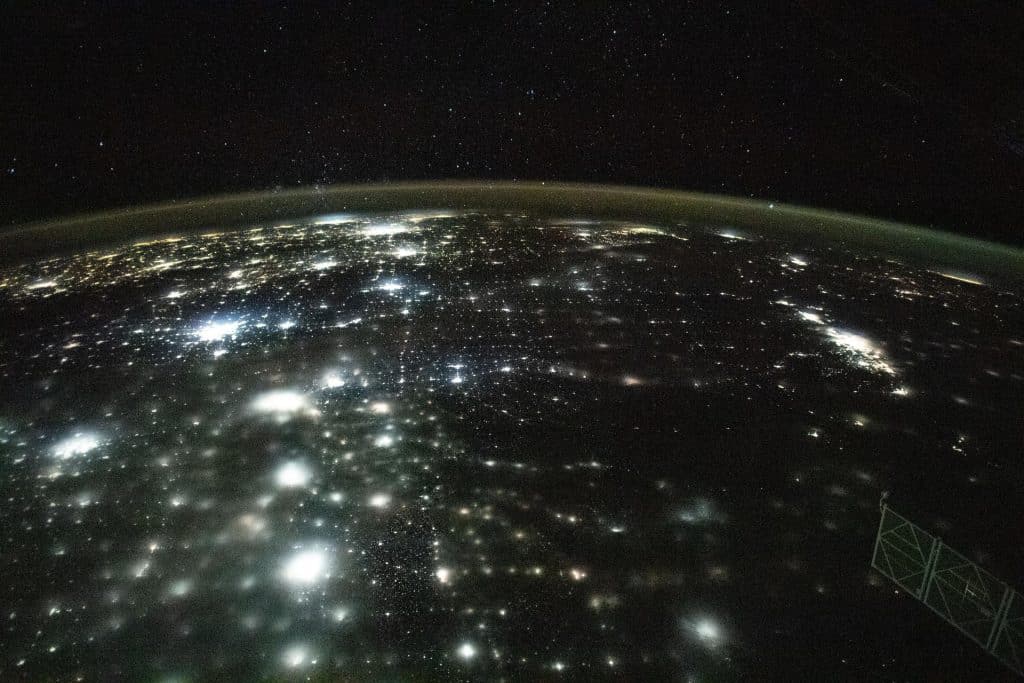
The answer is energy. Google says solar panels in low Earth orbit can produce up to eight times more power than the same panels on the ground, with sunlight almost all the time. In orbit there is no interconnection queue at the local utility, no neighbors objecting to a new substation and no water needed for cooling. On Earth, the industry is running into all three. As we covered in our look at data-center growth and the grid, demand for AI power is outrunning the speed at which utilities can build.
The money behind that demand is enormous. At Google’s developer conference in May, CEO Sundar Pichai said demand for AI services exceeds supply and that capital spending this year would be $180 billion to $190 billion, more than six times the 2022 level. And Google isn’t alone in looking up. Startup Starcloud launched a spacecraft with an Nvidia H100 chip last November and ran a version of Gemini from orbit, and SpaceX has said it expects to start deploying orbital AI compute satellites as early as 2028. What sets Google’s effort apart is its horizon: Beals frames Suncatcher as a long-term project aimed at the AI workloads of five years from now, not today’s. (Google had a busy day: its new Gemini 4 Argon model also landed today.)
The catch: launch costs, and physics
On the same day as the launch, Google released a peer-reviewed version of its orbital data-center white paper, due to be published in the journal Joule. The authors stress it is not an economic feasibility study, but it does show how Google expects rocket prices to fall. Arguing that SpaceX has cut launch costs by about 20% a year since its first rocket, the paper projects prices close to $200 per kilogram by 2035. To follow that curve, Starship would need to lift roughly 370,000 tons to orbit. TechCrunch calculates that at about 1,800 launches over ten years, or 180 a year, for a rocket that has never flown more than five times in one year.
Independent analysts agree on the direction, not the date. Boston Consulting Group estimates orbital data centers would carry a cost premium of 2.5 to 3 times today, and notes that at about $1,500 per kilogram, putting a gigawatt of computing in orbit would take roughly $30 billion just in launch costs. Analysts quoted by Data Center Knowledge say today’s $2,500 to $3,000 per kilogram needs to drop to about $200 to $500 before the math works. And launch is not the only problem:
- Repairs are impossible. On the ground a failed chip gets swapped. In orbit, BCG notes, a failure may mean retiring the whole satellite, so failure rates feed straight into cost.
- Data still has to come home. Every prompt goes up and every answer comes down, and analysts flag limited uplink and downlink capacity.
- Formation flying is hard. To share work, satellites must know their exact positions relative to each other and hold laser links Google compares to hitting a coin-sized target from miles away while both ends move.
- Training is a bad fit, for now. Radiation-induced errors are tolerable for answering queries but, by Google’s own account, a problem for huge training runs. Expect inference, not model training, to go to orbit first.
| Factor | Ground AI data center | Orbital AI data center (vision) |
|---|---|---|
| Power | Local grid, plus on-site generation; competes with homes and businesses | Near-constant sunlight, up to 8x the output of the same panels on Earth |
| Cooling | Air or water | Radiators only; heavy and expensive to launch |
| Repairs | Swap failed parts | A failure may retire the satellite |
| Best-fit work | Training and inference | Inference first; error rates make big training runs harder |
| Cost today | Baseline | About 2.5x to 3x higher (BCG) |
| Earliest scale | Now | Google: two-satellite test in 2027; cheap launches around 2035 |
Back on Earth: who pays for AI’s power?
While Google looks to the sky, Congress is fighting over the bill. The Ratepayer Protection Act would have set federal standards that state regulators must weigh when reviewing new customers that need 100 megawatts or more, including whether data centers and other huge users should cover the cost of the grid built to serve them. It passed the House earlier in September by 417 to 3. On 30 September it failed in the Senate, 57 to 43, short of the 60 votes needed to overcome a filibuster. Only four Democrats, Maggie Hassan, Amy Klobuchar, Jon Ossoff and Raphael Warnock, voted with Republicans.
Senate Democratic leader Chuck Schumer called the bill “toothless” because it asks states to consider the standard rather than requiring it. He is backing the GRID Savings Act, introduced in July by New Mexico Senator Martin Heinrich, which would require users of 150 megawatts or more to pay for the grid upgrades needed to connect them. With the midterms weeks away, both parties want to be seen acting on power bills, and some critics called the Republican bill a pre-election move.
How much of that cost reaches ordinary customers? NPR’s reporting, published today, finds there is no single answer: it varies by utility and state, but experts agree residential customers end up paying a share. Data centers push up wholesale power prices by adding demand, and someone has to pay for the new power lines and substations that connect them. “Everyone pays those costs,” Ari Peskoe of the Harvard Electricity Law Initiative told NPR, because they are spread across every home and business with a meter in the region. Because the industry is in a hurry, utilities may also turn to less efficient power plants, and those costs get passed on too. There is a counterpoint: NPR also cites evidence that communities near data centers can see better grid reliability and fewer outages, thanks to the heavy-duty infrastructure those sites need.
That is why Suncatcher matters even if it never scales. It is a signal of how badly the AI industry wants power it doesn’t have to fight for. As we argued in our look at AI’s multi-trillion-dollar revenue gap, the buildout has to pay for itself somehow, and electricity is now one of the biggest line items.
The security and data questions orbital AI raises
Nobody is processing customer data on Google’s test satellite, but space-based compute is moving from slideware to hardware, and the questions a security or compliance team would ask are worth settling now, before a vendor pitches “space cloud” capacity:
- Where is the data, legally? Most data-residency clauses name countries or cloud regions. Check whether yours would even cover processing on a satellite, and require vendors to disclose it.
- The links are the attack surface. Uplinks, downlinks, ground stations and laser links between satellites all carry your prompts and outputs. Ask how each hop is encrypted and authenticated end to end.
- No hands-on forensics. You can’t pull a drive from a satellite after an incident. Ask how logs are kept on the ground, how software and firmware are patched remotely, and what happens to your data when a satellite is retired.
- Radiation is an integrity risk. Google’s own tests show rare logic errors. For outputs that drive real decisions, ask what error detection, redundancy or re-checking is in place.
- Coverage and contracts. Confirm your cyber and technology insurance and your vendor contracts don’t exclude new infrastructure by accident. Our guide to AI exclusions in cyber insurance covers the gaps to look for.
7 steps to take now
- Map where your AI runs. List your AI and cloud providers and the regions your workloads run in. If you have facilities in fast-growing data-center regions, such as PJM’s territory in the mid-Atlantic and Midwest, note it: that’s where power-cost pressure is showing up first.
- Read the price-change clauses. Check AI and cloud contracts for energy surcharges, price-change notice periods and your right to move regions or switch models. Power costs are a new reason prices can rise even as per-token prices fall.
- Right-size your models. Send routine tasks to smaller, cheaper models and save frontier models for work that needs them. It is the simplest way to cut both cost and energy. See why AI pilots overrun their budgets and the AI price war.
- Budget for higher electricity bills. If you operate in a data-center-heavy region, model a rise in your own power costs, follow your utility’s rate cases and large-load tariff proposals, and look at efficiency and demand-response programs.
- Update your data-location policy. Require vendors to disclose where processing happens, including edge and future orbital locations, and to get approval before moving your data to new kinds of infrastructure.
- Stress-test any “space AI” pitch. Ask for the launch-cost assumptions, chip error rates, latency, uplink capacity and where your data is processed legally. A pitch that leads with free sunshine and skips launch economics deserves skepticism.
- Follow the rules being written. Track the Ratepayer Protection Act, the GRID Savings Act and your state utility commission’s data-center rules. Local rate cases are public, and business customers can comment.
Frequently asked questions
What is Google’s Project Suncatcher?
Project Suncatcher is a Google research moonshot, first revealed in November 2025, exploring whether satellites powered by sunlight and packed with Google’s TPU AI chips could one day form data centers in orbit. Its first prototype satellite, built by Planet, launched on SpaceX’s Transporter-18 mission on 1 October 2026 to test how the chips handle launch, radiation and cooling in space. Google plans a two-satellite test of laser links in 2027.
Why would anyone put AI data centers in space?
Mainly for power. In low Earth orbit, solar panels can get near-constant sunlight and, according to Google, generate up to eight times more power than on Earth. Orbit also avoids grid connection queues, local opposition and water use. The trade-offs are launch costs, cooling with radiators only, no way to repair hardware and limited bandwidth to the ground.
When will data centers in space be practical?
Not soon. Google’s own paper projects launch prices near $200 per kilogram around 2035, compared with roughly $2,700 on a Falcon 9 today, and BCG estimates orbital data centers would cost about 2.5 to 3 times more than ground facilities now. Early uses are likely to be AI inference rather than model training, because radiation-induced errors are more of a problem for long training runs.
Are AI data centers raising electricity bills?
In some regions, yes, though the amount varies by utility and state. One estimate cited by NPR puts the added cost for Maryland households at $168 to $216 a year, mainly from the data-center boom, and PJM’s independent market monitor estimates data centers cost its 67 million customers about $29 billion over roughly two years. Costs of new power lines and substations are often spread across all customers.
What is the Ratepayer Protection Act, and did it pass?
The Ratepayer Protection Act would have set federal standards that state regulators must consider when reviewing new electricity customers of 100 megawatts or more, including whether they should pay for the grid infrastructure built for them. It passed the House 417 to 3 but failed in the Senate on 30 September 2026 by 57 to 43, short of the 60 votes needed. Senate Democrats back the GRID Savings Act, which would require users of 150 megawatts or more to pay for grid upgrades.
Is it safe to process business data on a satellite?
It is too early to say, because no orbital service handles customer data at scale yet. Businesses should ask any vendor where data is processed legally, how ground stations and satellite links are encrypted and authenticated, how logs and patches are handled when hardware can’t be physically accessed, and how radiation-induced computing errors are detected.
Sources
- NPR: Google launches Project Suncatcher, a step towards AI data centers in space
- TechCrunch: Google thinks SpaceX's Starship has to launch 1,600 times before space data centers get off the ground
- Google: Behind Project Suncatcher, our moonshot to put AI in space
- KPBS (NPR): Google launches Project Suncatcher
- NPR: AI data centers, how much are ratepayers on the hook for?
- Al Jazeera, Reuters and AP: US Senate rejects bill targeting AI data centre electricity costs
- Newsweek: Congress targets data centers, what it could mean for home prices and bills
- BCG: Space-based data centers, more than hype but not a revolution
- Data Center Knowledge: Space data centers inch toward reality, with caveats
- Forbes: Data centers in space? Coming soon, but with down-to-earth hurdles