

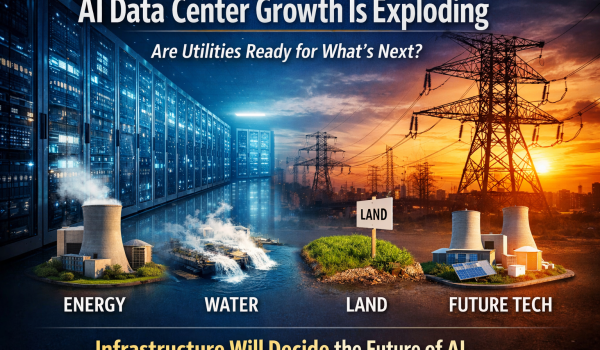
The limiting factor for AI is shifting from algorithms and chips to electricity, grid connections, cooling water and land. Every model query, every AI agent and every automated workflow runs on physical infrastructure, and that infrastructure is being built faster than the utility systems that power it can expand.
This matters beyond the energy industry. Power constraints are already shaping where data centers are built, how quickly cloud providers can add AI capacity, and what that capacity costs. For any business that plans to rely on AI, the energy story is part of the technology strategy, whether or not it owns a single server.
How fast demand is growing
The International Energy Agency’s Energy and AI report, published in April 2025, estimated that data centers used about 415 terawatt-hours of electricity in 2024, roughly 1.5% of global consumption. Their use has grown around 12% per year since 2017, more than four times faster than electricity demand overall. The IEA projects it will more than double to around 945 TWh by 2030, with the United States accounting for the largest share of the increase.
The US picture is sharper still. A Lawrence Berkeley National Laboratory report released by the Department of Energy in December 2024 found that data centers consumed about 4.4% of US electricity in 2023, or 176 TWh. It projected that share could reach between 6.7% and 12% by 2028, or 325 to 580 TWh. The width of that range reflects genuine uncertainty about how fast AI adoption and chip efficiency will move, but even the low end represents growth utilities have not seen in decades.
Individual facilities explain why. According to the IEA, a typical AI-focused data center consumes as much electricity as 100,000 households, and the largest ones under construction will use about 20 times that. A single campus can ask a regional utility for as much new capacity as a mid-sized city.
Why utilities are struggling to keep up
Electricity demand in many developed economies was nearly flat for years, and utilities planned accordingly. The sudden arrival of large, concentrated loads exposes several bottlenecks at once:
- Transmission. The IEA notes that new transmission lines take four to eight years to build in advanced economies, far longer than a data center.
- Equipment. Lead times for transformers and high-voltage cables have roughly doubled in three years, according to the IEA.
- Interconnection queues. New generation and large loads wait years for grid connection studies and approvals in many US regions.
- Reliability. Data centers need continuous power, so utilities must add firm capacity, not just intermittent supply, while keeping service reliable for existing customers.
- Water and land. Many cooling designs use significant water, which is contested in drought-prone regions, and sites need proximity to substations and fiber.
The IEA estimates about 20% of planned data center projects could face delays because of grid constraints. There is also a cost-allocation question that regulators are now weighing: who pays for the new lines and plants, the data center operators or all ratepayers.
How the industry is responding
Operators are not waiting for the grid. The main responses include:
- Long-term deals for firm power. In 2024 Microsoft signed a 20-year agreement with Constellation Energy to restart a unit at the Three Mile Island site in Pennsylvania, and Google and Amazon announced agreements to develop small modular reactors with Kairos Power and X-energy respectively.
- On-site generation and microgrids. Gas turbines, fuel cells and battery storage installed at or near the campus to bridge the years before grid upgrades arrive.
- Efficiency. Liquid cooling, higher-efficiency chips and heat reuse reduce the energy and water needed per unit of computing.
- Location strategy. Building where power and land are available, even if that is far from traditional data center hubs.
Several of these, particularly new nuclear, will not deliver meaningful power until around the end of the decade, which is why near-term constraints are likely to persist.
What it means for businesses that use AI
Most companies will never negotiate with a utility for data center power, but they will feel the effects through their cloud and AI providers. Practical implications:
- Expect capacity limits and pricing pressure for high-end AI. The most powerful GPU capacity may be rationed, regionally constrained or priced at a premium. Budget for it rather than assuming costs only fall.
- Right-size your models. Smaller or specialized models, often combined with retrieval, can deliver the same business result with a fraction of the computing, which lowers both cost and exposure to capacity constraints.
- Plan for regional resilience. If your workloads depend on a single cloud region, check where that region sits relative to grid stress and whether you can fail over elsewhere.
- Ask vendors about energy and emissions. Customers, investors and some regulators increasingly expect disclosure of the footprint of digital services. Knowing your providers’ energy sourcing helps with sustainability reporting.
- Measure AI value per unit of compute. Treat computing as a scarce input. Pilots that burn large amounts of inference without clear business value are harder to justify when capacity is tight; see AI Cost Overruns in 2026.
The trade-off is between speed and efficiency. The fastest path to AI results is often the largest model available, but in a power-constrained market the more efficient architecture tends to be both cheaper and more dependable. Our earlier piece on Green IT covers the sustainability side in more detail.
Frequently asked questions
How much electricity does AI actually use?
AI is one part of total data center use, which the IEA put at about 415 TWh in 2024, around 1.5% of global electricity. AI is the fastest-growing share and the main reason the IEA expects data center demand to roughly double by 2030.
Will AI demand cause higher electricity bills for households and businesses?
It can in some regions, depending on how utilities and regulators allocate the cost of new generation and transmission. Several US states are reviewing rate structures for very large loads so that other customers do not carry the cost.
Does this affect small businesses that only use cloud AI tools?
Indirectly. Constraints on power and data center capacity can influence the price and availability of advanced AI services. Choosing efficient models and providers with spare capacity reduces that exposure.
Plan AI around real-world constraints
Delana Technologies helps businesses build AI strategies that account for cost, capacity and efficiency, from choosing right-sized models to planning resilient cloud architecture. Learn more about our AI consulting and agentic AI solutions, call 239.414.5126 or contact us.
Sources: International Energy Agency, Energy and AI (April 2025); US Department of Energy and Lawrence Berkeley National Laboratory, 2024 United States Data Center Energy Usage Report (December 2024); company announcements from Microsoft and Constellation Energy (September 2024), Google and Kairos Power (October 2024), and Amazon and X-energy (October 2024).