

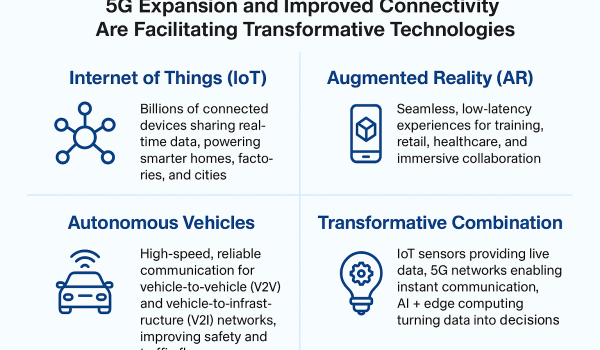
The headline feature of 5G was speed, but speed is not what makes it strategically important. What matters for business is that 5G networks can connect far more devices, respond with much lower delay, and be carved into dedicated slices with predictable performance. Those properties turn the mobile network from a way to reach the internet into infrastructure that machines, sensors and software can depend on.
That shift is what links 5G to the Internet of Things, augmented reality and connected vehicles. None of those depend on 5G alone; they depend on 5G combined with sensors that generate live data and AI running close to where the data is produced. This article explains what 5G actually adds, where it is delivering value today, where the promises are still ahead of reality, and how to decide whether it belongs in your plans.
What 5G adds beyond faster downloads
5G was designed around three sets of capabilities: enhanced mobile broadband (the speed most people notice), massive machine-type communications for connecting very large numbers of low-power devices, and ultra-reliable low-latency communications for applications where delay or dropped connections are unacceptable. The second and third are the ones that matter for industry.
Many of those capabilities depend on 5G standalone (SA) networks, which use a 5G core rather than piggybacking on 4G infrastructure. Standalone cores enable network slicing, where an operator reserves a logical slice of the network with guaranteed performance for a specific customer or application. Deployment is uneven: most early 5G networks were non-standalone, and operators have been rolling out standalone cores gradually.
Adoption is broad, even if the advanced features are still spreading. Ericsson’s June 2025 Mobility Report forecast about 2.9 billion 5G subscriptions worldwide by the end of 2025, roughly a third of all mobile subscriptions, rising to 6.3 billion by 2030. It also reported that 5G carried 35 percent of global mobile data traffic at the end of 2024 and that mid-band 5G covered over 90 percent of the population in North America.
IoT: from connected devices to connected operations
The Internet of Things is where 5G’s density matters most. Factories, warehouses, ports, hospitals and utilities want to connect thousands of sensors, cameras, robots and handheld devices in one location without the interference and roaming problems that can affect Wi-Fi in harsh or sprawling environments.
Private 5G networks, which an organization operates on its own site, have become a practical option here. In the US, the shared Citizens Broadband Radio Service (CBRS) spectrum lets enterprises deploy private LTE and 5G without buying exclusive licenses. Typical uses include tracking assets and autonomous mobile robots in warehouses, connecting machine sensors for predictive maintenance, and linking video analytics across large sites. We cover how these pieces fit together in The Convergence: Architecting Intelligent Connectivity with 5G and IoT.
Augmented reality and connected vehicles: promise and reality
Augmented reality benefits from 5G’s low latency because heavy rendering and AI processing can run on nearby edge servers rather than on the headset or phone. That makes lighter devices and richer experiences possible for use cases such as remote expert assistance in field service, guided assembly and maintenance, training simulations and retail try-before-you-buy. Adoption is real but still selective, often limited by device cost and comfort rather than the network.
Connected vehicles are a longer-term story. Vehicle-to-vehicle (V2V) and vehicle-to-infrastructure (V2I) communication can warn drivers and automated systems about hazards beyond line of sight, such as a stalled car around a bend or a red light about to change. In November 2024 the FCC adopted rules allowing cellular vehicle-to-everything (C-V2X) technology in the 5.9 GHz band, clearing a regulatory path in the US. Current deployments rely largely on LTE-based C-V2X, with 5G-based versions to follow. It is worth being clear that today’s self-driving systems depend mainly on onboard sensors and computing; network connectivity adds awareness and coordination rather than replacing them.
The real value: 5G plus edge computing plus AI
The transformative part is the combination. Sensors provide live data, 5G moves it reliably and quickly, and AI models running on edge servers near the site turn it into decisions in milliseconds instead of round-tripping to a distant cloud. That is what allows operations to shift from reactive (fix it when it breaks) to predictive (fix it before it breaks) and, in narrow, well-controlled settings, to autonomous (the system adjusts itself). Our overview of edge and ambient computing goes deeper on the edge side.
The same combination expands the attack surface. Every connected sensor, camera and controller is a device that needs to be inventoried, patched and segmented, and many IoT devices ship with weak defaults. Treat 5G and IoT projects as security projects from the start.
How to evaluate 5G for your business
5G is an enabler, not a strategy. Start from the operational problem and work backward:
- Identify the use case. Name the process you want to improve, such as equipment downtime, inventory accuracy or field service time, and the data that would help.
- Compare connectivity options honestly. Modern Wi-Fi, wired networks, LTE and low-power IoT networks are often enough. 5G earns its place with large sites, many devices, mobility, or strict latency and reliability needs.
- Decide public, private or hybrid. Carrier 5G suits wide-area and mobile use; private 5G suits a controlled site; many organizations will use both.
- Plan the data and AI layer. Decide where data will be processed, at the edge or in the cloud, and what decisions the models will make or support.
- Build security in. Inventory devices, segment IoT networks from business systems, enforce strong device identity and plan for patching over the device lifetime.
- Pilot and measure. Run a limited deployment with clear success metrics before scaling.
The trade-off is cost and complexity against capability. For many offices, 5G will simply be a better phone signal and a backup internet link. For asset-heavy operations, it can underpin a real change in how work is done. Our AI consulting services help design the edge AI layer, and our cybersecurity and compliance services cover IoT and network security.
Frequently asked questions
Do we need 5G to use IoT?
No. Many IoT deployments run on Wi-Fi, wired Ethernet, LTE or low-power networks such as LTE-M and NB-IoT. 5G becomes compelling when you need many devices in one place, mobility across a large site, or very low latency and high reliability.
What is a private 5G network?
A 5G network deployed for a single organization’s site, such as a factory, campus or port. It gives the organization control over coverage, capacity and security, and in the US can use shared CBRS spectrum rather than licensed carrier spectrum.
Is 5G secure?
5G includes stronger security features than earlier generations, such as better protection of subscriber identities. The bigger risks usually come from the devices and applications connected to it, so device security, segmentation and monitoring remain essential.
Building on the 5G backbone
Delana Technologies helps organizations decide where 5G, IoT and edge AI will pay off, design secure architectures around them, and run pilots that prove the value before scaling. To talk through a use case, call 239.414.5126 or contact us.
Sources: Ericsson Mobility Report (June 2025); Federal Communications Commission, rules for C-V2X in the 5.9 GHz band (November 2024); 3GPP descriptions of 5G usage scenarios (eMBB, mMTC, URLLC); FCC documentation on the Citizens Broadband Radio Service.