

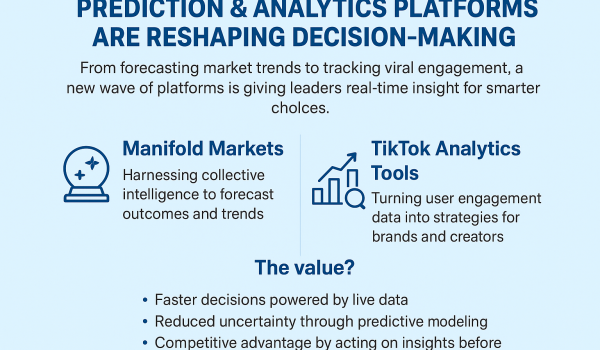
Two kinds of platform are changing how leaders form expectations about the future. Prediction platforms such as Manifold Markets pool the judgment of many people into a single probability for an outcome. Social analytics tools, including TikTok’s own analytics and trend dashboards, show in near real time what audiences are paying attention to. Both promise the same thing: earlier, better-grounded decisions.
Used well, they reduce uncertainty and help a company act on a signal before competitors notice it. Used carelessly, they produce confident-looking numbers from thin data and push teams toward whatever is trending this week. This article explains how each type of platform works, where it is genuinely useful, and how to fold it into a disciplined decision process.
How prediction markets turn opinions into probabilities
A prediction market lets participants buy and sell shares in the outcome of a question, such as “Will this product ship by March?” or “Will the central bank cut rates at its next meeting?” The price of a share, between 0 and 100, reads as the crowd’s estimated probability. People who believe the price is wrong have an incentive to trade against it, and over time prices tend to incorporate the information scattered across many participants.
Manifold Markets is a well-known example that operates with play money: users trade a virtual currency, and anyone can create a market on almost any question. Other platforms, such as the federally regulated exchange Kalshi, involve real money and a narrower range of approved contracts. Research on forecasting, including the Good Judgment Project led by Philip Tetlock, has shown that aggregating many careful forecasters often beats individual experts, which is the core idea these platforms rely on.
For businesses, the most practical use is often internal. Companies including Google have experimented with internal prediction markets for questions such as launch dates and adoption targets. Employees closest to the work frequently know that a deadline will slip long before it appears on a status report, and an anonymous market gives that knowledge a way to surface.
Social analytics: reading attention in real time
Social platforms have become one of the fastest indicators of consumer interest. TikTok’s built-in analytics show brands and creators how content performs, including views, watch time, audience demographics and follower activity, and its Creative Center surfaces trending hashtags, sounds and ad formats. Third-party social listening tools extend this across platforms.
The value is speed. A product mention that takes off, a complaint that spreads, or a new use for an existing product can show up in engagement data days or weeks before it appears in sales figures or surveys. Marketing teams use this to adjust campaigns quickly; product and customer service teams can use it to spot problems early.
The limitation is that engagement measures attention, not intent. A video with millions of views may reflect curiosity or mockery, and platform audiences are not representative of every customer base. Social data works best as an early signal to investigate, not as the answer itself. We look at how AI is changing social platforms more broadly in The AI Shift on Social Media.
Where these tools help, and where they mislead
Prediction and analytics platforms add the most value when a question is specific, the outcome can be checked, and relevant knowledge is spread across many people. They are weaker in other situations:
- Thin participation. A market with a handful of traders reflects a handful of opinions. Low liquidity makes prices easy to move and easy to misread.
- Vague questions. “Will the product be successful?” cannot be resolved cleanly, so the forecast means little. Good questions have a clear answer and a date.
- Vanity metrics. Views and likes are easy to count and easy to over-interpret. They matter only when they connect to outcomes such as leads, sales or retention.
- Platform and data risk. Relying on one platform’s analytics ties your insight to its policies and availability, and any data you export must be handled under privacy rules.
Putting prediction and analytics into your decision process
The goal is not to hand decisions to a crowd or a dashboard. It is to add better inputs to the decisions leaders already make. A practical way to start:
- Pick decisions that matter and recur. Launch timing, demand for a new offering, campaign performance and hiring needs are good candidates because you can learn from repeated forecasts.
- Write resolvable questions. Define the outcome, the date and the source of truth before anyone forecasts.
- Combine signals. Put crowd forecasts and social signals next to your own sales, CRM and operational data rather than treating any single source as definitive.
- Tie social metrics to business outcomes. Track which engagement patterns actually precede leads or sales, and report on those instead of raw reach.
- Keep score. Record forecasts and compare them with what happened. Over time you learn which sources, teams and methods deserve more weight.
- Govern the data. Decide what internal information can be used in forecasting exercises, and make sure analytics exports respect customer privacy and platform terms.
The trade-off is effort. Maintaining good questions and tracking accuracy takes discipline, and the payoff comes from repetition rather than a single brilliant forecast. Organizations that stick with it build a clearer view of which signals to trust. Our data analytics and BI services help connect external signals to internal data, and our AI consulting services build predictive models on top of it. For the people behind this kind of work, see The Data Scientist and Data Engineer Duo.
Frequently asked questions
Are prediction markets legal for businesses to use?
Play-money and internal markets that do not involve real-money wagering are generally straightforward to run. Real-money markets are regulated, in the US by the Commodity Futures Trading Commission, so consult counsel before offering anything with cash stakes.
How accurate are crowd forecasts?
Accuracy depends on participation, question quality and whether participants have relevant knowledge. Well-run forecasting efforts have outperformed individual experts in research settings, but a small or uninformed crowd offers little advantage.
Is TikTok analytics useful for B2B companies?
It depends on whether your buyers are there. For many B2B firms, TikTok is more useful for recruiting and brand awareness than for lead generation. The same principle applies on any platform: measure what connects to your actual business outcomes.
Turning signals into better decisions
Delana Technologies helps organizations bring forecasting, social analytics and internal data together into dashboards and models that leaders can trust and act on. To discuss which decisions would benefit most from better forecasting, call 239.414.5126 or contact us.
Sources: Manifold Markets documentation and announcements (2025); Philip Tetlock and Dan Gardner, Superforecasting (2015), on the Good Judgment Project; Google research on internal prediction markets (Cowgill, Wolfers and Zitzewitz); TikTok for Business analytics and Creative Center documentation; Commodity Futures Trading Commission materials on event contracts.