

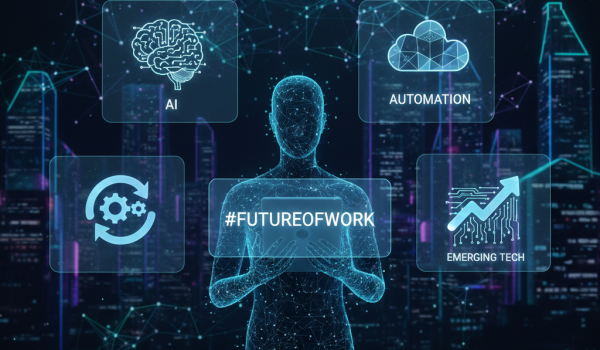
Every enterprise now has more emerging technology options than it can possibly pursue: generative AI, AI agents, IoT, edge computing, advanced analytics and more. The organizations pulling ahead are not the ones experimenting with the most of them. They are the ones with a disciplined way to move a small number of promising ideas from research and pilot into production, and to stop the rest early.
That discipline is what “the future is built today” means in practice. Innovation, emerging technology and AI reshape an enterprise only when they are connected to business outcomes, governed responsibly and run as an ongoing pipeline rather than a series of disconnected pilots. This article lays out how to build that pipeline.
The pilot problem
The gap between experimentation and impact is well documented. In August 2025, MIT’s NANDA initiative published “The GenAI Divide: State of AI in Business 2025,” which reported that the large majority of enterprise generative AI pilots, around 95% by its measure, were producing no measurable impact on profit and loss. The researchers pointed less to model quality than to poor integration with workflows and tools that did not learn from use.
Gartner reached a similar conclusion for AI agents. In June 2025 it predicted that over 40% of agentic AI projects would be canceled by the end of 2027 because of escalating costs, unclear business value or inadequate risk controls. Neither finding says the technology does not work. Both say that most organizations lack a reliable path from promising demo to operational value. We explore the cost side in AI Cost Overruns in 2026.
From R&D to real-world impact: a stage-gated pipeline
Innovation used to live in labs. Today R&D is expected to connect directly to operations, linking cloud, IoT, edge and AI into systems that run the business. A stage-gated pipeline makes that connection explicit. Each idea passes through defined stages, and at each gate it either earns more investment or stops:
- Problem framing. State the business outcome, the owner and the metric. “Reduce invoice processing time by half” qualifies. “Explore generative AI” does not.
- Feasibility check. Confirm the data exists and is usable, the integration points are known, and legal, security and privacy constraints are understood. Many ideas should stop here, cheaply.
- Time-boxed pilot. Run a limited trial, typically six to twelve weeks, with real users and real data, measured against a baseline.
- Production readiness review. Before scaling, check security, monitoring, support ownership, total cost of operation and the change management plan for affected staff.
- Scale and operate. Roll out with an operating budget, not just a project budget, and keep measuring against the original metric.
- Retire or reinvest. Review results periodically. Solutions that stop paying off are retired; those that succeed become templates for the next use case.
The value of the gates is in the stopping. A portfolio in which most ideas end at the feasibility or pilot stage, quickly and cheaply, is healthy. One in which every pilot lingers indefinitely drains budget and credibility.
Choosing the right mix of emerging technologies
Modern innovation is not about chasing every new tool. It is about integrating the technologies that serve specific outcomes. A manufacturer might combine IoT sensors, edge processing and machine learning to improve production quality. A healthcare organization might use generative AI to draft clinical documentation, with clinicians reviewing every note. A professional services firm might start with retrieval-augmented generation over its own knowledge base.
A simple scoring model helps compare options: expected business value, data readiness, integration complexity, risk level and the organization’s ability to support the solution once it is live. Scoring forces an honest conversation about why a given project should go first, and it keeps the portfolio balanced between quick wins and longer bets.
Be wary of two common distortions. The first is choosing projects because a vendor is offering free credits or a board member saw a demo, rather than because the problem matters. The second is favoring the most technically interesting option over the one that fits existing systems. A modest solution that plugs into the ERP, CRM or ticketing platform people already use will usually outperform an impressive standalone tool that asks them to change how they work.
AI as a creative and strategic co-pilot
AI has moved beyond analytics into creative and strategic work. Teams use it to brainstorm product ideas, generate design variations, write and test code, summarize research and model scenarios. Used well, it accelerates R&D itself: more options explored, faster prototypes, and quicker learning about what does not work.
The most forward-looking organizations use AI for inspiration as well as efficiency, pairing human judgment with machine speed. The human role remains decisive: choosing which ideas matter, judging quality, and taking responsibility for the result. For how autonomous agents fit in, see Agentic AI in 2026.
Innovating responsibly
Ethical design, transparency and governance are now part of innovation strategy rather than an afterthought. The next phase of AI adoption will favor organizations that can show how their systems make decisions, what data they use, and how problems are caught. The NIST AI Risk Management Framework, released in 2023, offers a practical structure built around four functions: govern, map, measure and manage.
In the pipeline above, responsible AI is not a separate committee. It is built into the gates: data rights and privacy at feasibility, bias and accuracy testing during the pilot, and security, monitoring and human oversight at the production readiness review. That integration costs some speed early and saves far more later, when a system is already in customers’ hands.
Frequently asked questions
Why do so many AI pilots fail to reach production?
Common causes are vague goals, poor integration with existing workflows, underestimated operating costs, missing data, and risk concerns raised too late. A stage-gated process surfaces these issues before major spending.
How many innovation projects should we run at once?
Fewer than most organizations attempt. A mid-sized company typically does better with two or three well-supported pilots than with a dozen under-resourced ones.
Who should own the innovation pipeline?
A senior business sponsor should own outcomes, supported by a small cross-functional team from IT, security, data and the affected business units. Each individual project needs a named business owner.
Build what lasts
Delana Technologies helps enterprises select, pilot and scale AI and emerging technology with the governance and measurement that get projects into production. Explore our AI consulting and agentic AI solutions, or call 239.414.5126 or contact us.
Sources: MIT NANDA, “The GenAI Divide: State of AI in Business 2025” (August 2025); Gartner press release, “Gartner Predicts Over 40% of Agentic AI Projects Will Be Canceled by End of 2027” (June 25, 2025); NIST AI Risk Management Framework 1.0 (January 2023).