

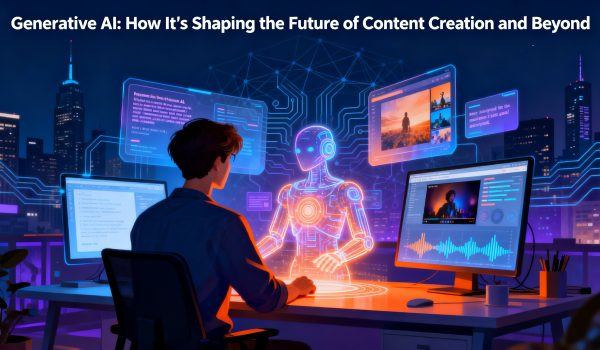
Generative AI has changed the economics of content. A first draft of a blog post, a set of product images or a 30-second explainer video can now be produced in minutes rather than days, using models from OpenAI, Anthropic, Google and a growing field of specialist tools. For marketing teams, agencies and small businesses, the question is no longer whether the technology works, but how to use it without flooding the world with forgettable material or creating legal problems.
The organizations getting real value treat generative AI as a production engine inside a human editorial process, not as a replacement for one. The model handles volume, variation and first drafts; people supply the ideas, the expertise, the judgment about what is true and the voice that makes content worth reading. This article covers what each type of generation is good for, how to build a workflow around it, and the rules that now apply.
Text: from blank page to first draft
Large language models such as OpenAI’s GPT models, Anthropic’s Claude and Google’s Gemini, the successor to the PaLM models that powered Google’s early efforts, write fluent text in almost any format. In business content they are strongest at:
- Turning notes, transcripts or bullet points into structured drafts.
- Producing variations of the same message for different audiences, channels and lengths.
- Repurposing one piece of content, such as a webinar, into articles, emails and social posts.
- Editing for clarity, tone and consistency against a style guide.
They are weakest at original insight and verified facts. A model will confidently produce statistics, quotes and citations that do not exist unless it is grounded in real sources. Every factual claim in AI-assisted content needs to be checked by a person before publication.
Images and video: capable, but with caveats
Image generators such as OpenAI’s DALL·E and Midjourney made photorealistic images and illustrations available from a text prompt, and they are now built into mainstream design tools. They are useful for concept art, backgrounds, social graphics, mock-ups and variations on a campaign theme.
Video has moved quickly. Runway was an early leader in text-to-video, and in the last year OpenAI’s Sora and Google’s Veo models brought short, high-quality generated clips, including synchronized audio in Veo 3, to a wide audience. For businesses the most practical uses today are short social clips, product explainers, B-roll and localized versions of existing videos.
The caveats are real. Generated images can contain distorted details, text errors and unintended resemblances to real people or trademarks. Video is still limited in length and consistency. And audiences are increasingly quick to spot, and discount, content that looks generic.
An editorial workflow that keeps quality high
The difference between useful AI content and noise is the process around the model. A workflow that works for most teams:
- Start from a human brief. Define the audience, the point of view and the specific expertise the piece should carry. AI cannot supply your company’s experience.
- Ground the model in real material. Provide your own notes, interviews, data and approved sources rather than asking the model to write from its general knowledge.
- Iterate, don’t one-shot. Use the model to outline, draft, critique and revise in several rounds, with a person steering each step.
- Fact-check every claim. Verify statistics, names, dates, quotes and product details against primary sources.
- Edit for voice. A human editor makes the final pass so the piece sounds like your brand and adds the specific examples that make it credible.
- Check rights and likeness. Review images and video for logos, recognizable people and anything resembling protected work.
- Record what was AI-assisted. Keep a simple log of which tools were used on which assets, which helps with disclosure and copyright questions later.
Search engines take the same view. Google’s guidance is that it rewards helpful, original content regardless of how it is produced, but mass-produced pages created mainly to rank are treated as spam. Our piece on Generative Engine Optimization covers how AI is also changing how content gets discovered.
The legal and ethical rules that now apply
Several rules are already in force, and more are arriving:
- Copyright ownership. In January 2025 the US Copyright Office concluded that prompts alone do not give a person enough control over the output to claim copyright in purely AI-generated material. Human selection, arrangement and substantial modification can be protected. If owning your content matters, keep meaningful human authorship in the process.
- Fake reviews and endorsements. The FTC’s rule on consumer reviews and testimonials, in effect since October 2024, prohibits fake reviews, including AI-generated ones that misrepresent a real customer’s experience.
- Disclosure of synthetic media. The EU AI Act’s transparency obligations, which apply from August 2026, require deepfakes and certain AI-generated content to be labeled. Several US states have their own rules for AI in political ads.
- Confidentiality. Pasting client material or unreleased product details into a consumer AI tool can breach contracts. See Shadow AI in 2026 for how to set sensible rules.
Beyond content: the wider business impact
The same models behind content creation are reshaping other functions: customer service assistants that draft replies, sales teams that personalize outreach at scale, analysts who summarize research, and operations teams that automate document-heavy work. The pattern is the same as in content. Generative AI takes on the drafting and the volume, and people concentrate on judgment, relationships and quality control.
The practical lesson for leaders is to measure outcomes rather than output. Ten times more content is not a win if engagement, conversions or customer satisfaction stay flat. The teams that benefit most use the time generative AI saves to do more research, talk to more customers and publish fewer, better pieces.
Frequently asked questions
Can we copyright content created with generative AI?
Only the parts that reflect human authorship. The US Copyright Office has said prompts alone are not enough, but human selection, arrangement and substantial editing of AI output can be protected. Keeping records of human contributions helps.
Does Google penalize AI-generated content?
Not for being AI-generated. Google evaluates helpfulness and originality, and treats content mass-produced mainly to manipulate rankings as spam, whether a person or a model wrote it.
Should we tell customers when content is AI-generated?
Disclosure is legally required in some cases, such as certain synthetic media under the EU AI Act, and is good practice wherever a reader might otherwise be misled about who created something or whether a person or event is real.
Put generative AI to work responsibly
Delana Technologies helps businesses build generative AI into their content and operations, from tool selection and grounded workflows to data protection and governance. Explore our AI consulting and agentic AI solutions, call 239.414.5126 or contact us.
Sources: US Copyright Office, “Copyright and Artificial Intelligence, Part 2: Copyrightability” (January 2025); Federal Trade Commission, Trade Regulation Rule on the Use of Consumer Reviews and Testimonials (2024); EU Artificial Intelligence Act, Article 50; Google Search Central guidance on AI-generated content.