

Sustainable technology has stopped being a public relations topic and become an operating decision. Electricity is one of the fastest-growing costs in IT, customers and regulators are asking for emissions data, and hardware refresh cycles generate waste that someone has to account for. The organizations that treat efficiency as an engineering discipline tend to spend less and answer those questions more easily.
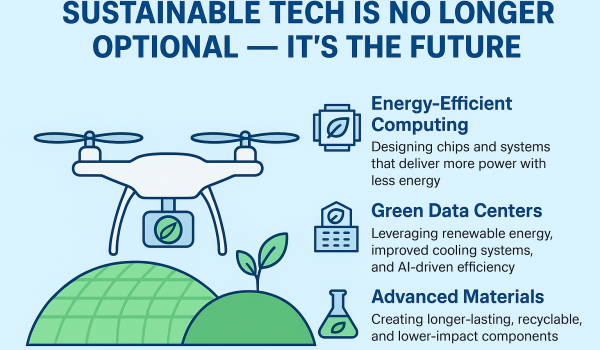
Three developments lead the change: more energy-efficient computing, greener data centers, and hardware built from longer-lasting, recyclable materials. None of them requires a company to become a climate leader. They require the same habits good IT management already demands: measure what you run, remove what you do not need, and buy with the full lifecycle in mind. This article looks at each area and what a mid-sized business can realistically do.
Why sustainability became an IT problem
The scale of computing’s energy use has grown quickly. The International Energy Agency’s 2025 report Energy and AI estimated that data centers used about 415 terawatt-hours of electricity in 2024, roughly 1.5 percent of global consumption, and projected that figure to more than double to around 945 terawatt-hours by 2030, driven largely by AI. The United States accounts for the largest share of that growth. We look at what this means for the power grid in AI Data Center Growth Is Exploding.
Hardware is the other half of the picture. The UN’s Global E-waste Monitor 2024 reported that the world generated about 62 million tonnes of electronic waste in 2022, and only around 22 percent was documented as properly collected and recycled. Laptops, servers and network gear retired early become a disposal cost and, if drives are not properly wiped, a data security risk.
Reporting rules are catching up. The EU’s Corporate Sustainability Reporting Directive began phasing in for the largest companies with 2024 reports, the EU’s revised Energy Efficiency Directive requires larger data centers to report their energy performance, and California’s climate disclosure laws will require large companies doing business in the state to report emissions. Smaller firms feel these rules through customer questionnaires asking for their share of emissions.
Energy-efficient computing
Chipmakers have steadily improved performance per watt, and processor designs based on Arm architecture, now common in laptops and cloud servers, often deliver comparable work for less power. For most businesses, though, the largest efficiency gains come from how existing computing is used rather than which chips are inside it.
Idle and oversized resources are the main waste. Cloud instances sized for peak demand that never arrives, development environments left running over weekends, and on-premises servers running at a small fraction of capacity all draw power for no output. AI workloads amplify the effect: running a very large model for a task a small model handles well can multiply energy use and cost with no benefit to the result. Right-sizing the model to the job is both a sustainability decision and a budget one.
Green data centers and cloud choices
Data center operators are attacking energy use from several directions: renewable power purchase agreements, more efficient cooling such as liquid cooling for dense AI hardware, heat reuse, and software that shifts flexible workloads to times or regions where cleaner power is available. Efficiency is commonly tracked with power usage effectiveness (PUE), the ratio of total facility energy to the energy that reaches IT equipment.
Most organizations do not run a data center large enough to redesign, but they choose where their workloads live. Moving from an ageing server closet to a modern colocation facility or public cloud region usually improves efficiency substantially. The major cloud providers publish sustainability data and offer carbon reporting tools, which make it easier to answer customer questionnaires with real numbers rather than estimates.
Advanced materials and the hardware lifecycle
Manufacturers are increasing the use of recycled aluminum, plastics and rare earth elements, designing devices that are easier to repair, and publishing product carbon footprints. Standards such as EPEAT and TCO Certified give buyers a practical way to compare products on energy use, materials and repairability without becoming experts.
The simplest lever is keeping equipment in service longer. Most of a laptop’s lifetime emissions come from manufacturing, so extending a refresh cycle by a year often does more than buying a more efficient replacement. When equipment does retire, certified refurbishment or recycling, with documented data destruction, closes the loop and protects the data on the drives.
A practical sustainable IT plan
Sustainable IT works best when it rides on existing cost and security work rather than becoming a separate program:
- Measure first. Pull energy and emissions data from your cloud providers, and estimate on-premises consumption from equipment inventories and utility bills.
- Remove waste. Shut down idle servers, schedule non-production environments to turn off out of hours, and right-size cloud instances and storage.
- Match AI models to tasks. Use smaller or specialized models where they perform well, and reserve large models for work that needs them.
- Consolidate hosting. Move workloads from inefficient server rooms to efficient facilities or cloud regions with cleaner power where practical.
- Buy for the lifecycle. Add energy, repairability and certification criteria to procurement, and extend refresh cycles where performance allows.
- Retire responsibly. Use certified e-waste and refurbishment partners and keep certificates of data destruction.
The trade-off to watch is greenwashing. Claims that cannot be backed with data create reputational and, increasingly, legal risk. Report what you measured, not what a vendor brochure promised. The payoff is real, though: lower operating costs, better answers for ESG-minded customers and investors, and fewer surprises when a large customer or regulator asks for your numbers. Our AI consulting services help teams choose efficient AI architectures, and our compliance services cover secure hardware disposal and reporting controls. For a deeper look at green IT practices, see Green IT: Building a Sustainable Digital Future.
Frequently asked questions
Does moving to the cloud make IT more sustainable?
Often, because large cloud facilities are typically more efficient than small server rooms and many buy significant renewable power. But the benefit disappears if workloads are oversized or left running unnecessarily. Efficiency depends on how you use the cloud, not just being in it.
Do small businesses need to report emissions?
Most are not directly required to. But large customers subject to reporting rules increasingly ask suppliers for emissions data, so having basic measurements ready can help win and keep contracts.
Is AI bad for sustainability?
AI adds significant energy demand, but it can also improve efficiency in areas such as cooling, logistics and building management. The practical question is whether each AI use case delivers enough value for its energy cost, and whether it uses the smallest model that does the job well.
Building a leaner, greener IT estate
Delana Technologies helps organizations cut wasted computing, choose efficient AI and hosting options, and retire hardware securely, so sustainability goals and IT budgets move in the same direction. To discuss where your IT estate can run leaner, call 239.414.5126 or contact us.
Sources: International Energy Agency, Energy and AI (2025); UN Institute for Training and Research and ITU, Global E-waste Monitor 2024; EU Corporate Sustainability Reporting Directive (Directive 2022/2464) and Energy Efficiency Directive (Directive 2023/1791); California SB 253 and SB 261 (2023).