

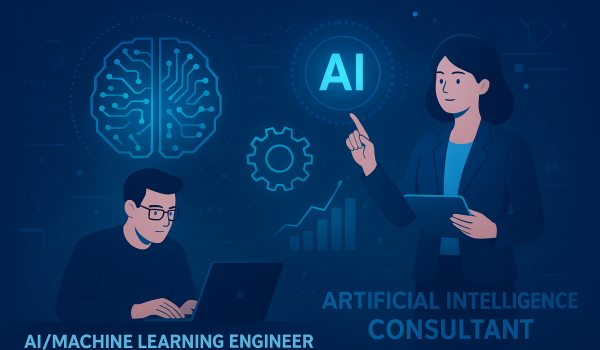
In a few short years AI has gone from a boardroom buzzword to a core part of how many businesses operate. The people leading that shift are not research scientists in distant labs. They are two kinds of practitioners working side by side: AI and machine learning engineers who build the systems, and AI consultants who decide where those systems should go and how the business will use them.
Neither role succeeds alone. Strategy without engineering produces slide decks and pilots that never ship. Engineering without strategy produces technically impressive models that solve the wrong problem or that nobody adopts. The organizations getting real value from AI treat these as two halves of one team. This article explains how that partnership works, who owns what, and how to structure it for your organization.
Two roles, one outcome
The AI engineer is the technical backbone. They design, build and operate systems that predict customer needs, detect anomalies, extract information from documents and automate routine tasks, in industries from finance to manufacturing. Their focus is on making AI work reliably: data pipelines, model selection, integration, testing, deployment and monitoring.
The AI consultant is the strategic translator. They help leadership identify where AI makes sense, estimate return on investment, manage risk and guide adoption. Their focus is on making AI matter: choosing the right problems, aligning stakeholders, designing new workflows and making sure people actually use what gets built.
The two roles share one outcome: a measurable improvement in how the business operates. Everything else is a means to that end.
Who owns what across the AI lifecycle
The clearest way to see the partnership is to follow a project from idea to production and note where each role leads.
- Opportunity discovery. The consultant leads, interviewing teams and mapping processes to find where AI could save time, reduce errors or create revenue. The engineer checks early whether the data exists to support each idea.
- Business case and prioritization. The consultant leads on value and risk; the engineer supplies realistic estimates of effort, cost and technical risk. Together they choose the first use case.
- Solution design. The engineer leads the architecture: build or buy, which models, how data flows, where humans stay in the loop. The consultant makes sure the design fits real workflows and governance requirements.
- Build and test. The engineer leads development and evaluation. The consultant organizes user testing and prepares the people and process changes.
- Rollout and adoption. The consultant leads training, communication and process change; the engineer handles deployment, monitoring and fast fixes.
- Operate and improve. Both track results against the original business case. The engineer maintains model performance; the consultant finds the next opportunity and feeds lessons back into the roadmap.
That feedback loop is what keeps AI systems both powerful and practical, and aligned with business goals rather than technical curiosity.
What goes wrong when one side is missing
The failure patterns are predictable enough to plan against.
Consultant without engineer. The organization gets a polished strategy, a long list of use cases and a vendor recommendation, but nobody can judge whether the data supports the plan or whether the chosen tool can integrate with existing systems. Projects stall at the first technical obstacle.
Engineer without consultant. A capable team builds a working model, but it addresses a problem leadership does not prioritize, or it requires staff to change how they work without anyone managing that change. Usage drops after launch and the project is quietly shelved.
Neither owns governance. Both roles assume the other is handling privacy, bias and security. Risk questions surface late, often from legal or a customer, and the project stops. Assigning governance explicitly, usually with the consultant leading and the engineer implementing controls, prevents this.
Handoffs treated as finish lines. When strategy is “done” before engineering starts, or engineering is “done” at launch, context is lost at each handoff. The consultant never learns what the data revealed, and the engineer never hears how users actually work. Keeping both roles involved, at different intensity, from discovery through the first months of operation avoids this.
Structuring the team for your size
How you combine these roles depends on your scale and maturity.
- Small businesses rarely need full-time AI staff. An outside partner who provides both strategic and engineering capability for a defined project, plus a named internal owner, is usually the most efficient model.
- Mid-sized organizations often benefit from one or two in-house engineers who own integration and operations, with consulting support for strategy, governance and larger initiatives.
- Large enterprises tend to build a central AI team or center of excellence that sets standards and shared platforms, with engineers embedded in business units and internal consultants or product managers acting as translators.
Whatever the size, keep three things constant: a single accountable business owner for each AI system, shared success metrics between strategy and engineering, and a regular review where both sides look at the same results.
If you use outside partners, write those expectations into the engagement. Ask for knowledge transfer, documentation and a clear handover plan so your team can run and improve the system without depending on the vendor indefinitely.
Frequently asked questions
Should we hire an AI engineer or an AI consultant first?
If you do not yet know where AI fits your business, start with strategy, but make sure it includes someone who can assess technical feasibility. If you already have a clear, well-defined use case, an engineer can often move faster. Many organizations begin with a partner who provides both.
Can one person do both roles?
Some experienced practitioners can, particularly on smaller projects. As projects grow, the workload and the different skill sets usually justify separate people, but they should work as one team with shared goals.
How do we measure whether the partnership is working?
Track the business metrics each AI system was meant to move, such as hours saved, error rates or revenue influenced, along with adoption rates among the people who are meant to use it. Technical metrics matter, but they are not the goal.
Bringing strategy and engineering together
Delana Technologies provides AI strategy and engineering as one team, from discovery and governance through build, rollout and ongoing improvement. Learn about our AI consulting and agentic AI solutions. For a closer look at each role, read Why the AI Consultant Is the Missing Piece in Your AI Strategy and Why AI / Machine Learning Engineers Are the Architects of Tomorrow’s Intelligence. To plan your next AI initiative, call 239.414.5126 or contact us.
Sources: NIST AI Risk Management Framework (AI RMF 1.0), including its guidance on assigning AI governance roles and responsibilities.