

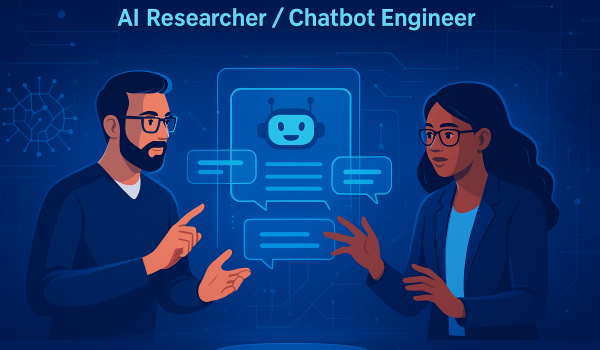
For decades we talked to machines in their language: menus, forms and keywords. Now machines can talk back in ours, and they improve at it every month. Behind that shift are two groups of specialists: AI researchers who develop the language models, and chatbot engineers who turn those models into assistants that customers and employees actually use.
Conversational AI has moved from rigid, scripted bots to systems that understand context, tone and intent. That makes it one of the most visible forms of AI in business, and one of the most exposed. When a chatbot gets something wrong, it does so in front of a customer, in writing. This article explains how the technology evolved, what the people building it do, where it delivers real value, and how to deploy it without creating new risks.
From scripts to systems that understand context
First-generation chatbots were decision trees. They matched keywords to prewritten answers and failed as soon as a customer phrased something unexpectedly. Most people who have typed “speak to a human” into a support window have met one.
Large language models changed that. Trained on vast amounts of text, they can interpret questions phrased in countless ways, keep track of a conversation and generate fluent answers. A key step in making them useful was reinforcement learning from human feedback (RLHF), the technique OpenAI described in its 2022 InstructGPT research, in which people rate model responses and the model is tuned toward the answers people prefer. RLHF and related methods are a large part of why modern assistants follow instructions, stay on topic and respond in an appropriate tone.
The result is that chatbots can now handle open-ended questions, summarize information and adapt to the user, rather than forcing the user to adapt to them.
What AI researchers and chatbot engineers actually do
AI researchers work on the underlying models: improving how they understand language, reason through problems, follow instructions and avoid harmful outputs. Most businesses will never employ one directly, but their work determines what is possible.
Chatbot engineers, sometimes called conversational AI engineers, build the systems businesses deploy. Their work includes:
- Grounding the model in company knowledge, typically with retrieval-augmented generation, so answers come from approved policies and documents rather than the model’s general training.
- Integrations with CRMs, order systems and ticketing tools, so the assistant can look up an account or open a case rather than just talk.
- Conversation design: defining tone, when to ask clarifying questions, and when to hand off to a person.
- Guardrails that keep the bot within scope, protect personal data and resist attempts to manipulate it through crafted prompts.
- Evaluation and monitoring, testing answers against known questions and reviewing real conversations for errors.
Knowledge graphs, sentiment detection and other classic natural language processing techniques still play a role, often alongside large language models.
Where conversational AI delivers business value
The strongest use cases share a pattern: high volume, repetitive questions, and answers that can be grounded in reliable information.
- Customer support for order status, account questions, policy explanations and troubleshooting, with escalation to staff for complex cases.
- Internal help desks for HR policies, IT requests and procedures, where employees get instant answers from company documentation.
- Sales and account analytics, where staff ask questions in plain language and get answers drawn from CRM and financial data.
- Business intelligence from conversations, since every chat reveals what customers struggle with, which products generate confusion and how sentiment is trending.
That last point is often overlooked. Transcripts are a steady stream of customer research, provided they are handled in line with your privacy commitments.
Measure value carefully. The share of conversations the bot handles without a person is a common metric, but on its own it can reward a bot that simply frustrates people into giving up. Pair it with resolution rates, customer satisfaction scores and a regular sample of transcripts reviewed by staff.
Accountability: lessons from real deployments
Chatbots speak for the business, and courts and regulators treat them that way. In February 2024, a Canadian tribunal ruled against Air Canada after its website chatbot gave a customer incorrect information about bereavement fares. The airline argued the chatbot was responsible for its own statements; the tribunal rejected that and held the company responsible for everything on its website, including the bot’s answers.
Sensitive domains raise the stakes further. In 2023 the US National Eating Disorders Association took down its chatbot, Tessa, after users reported it giving weight-loss advice that was inappropriate for people with eating disorders. Conversational AI can support mental health services, but only with tight scope, clinical oversight and fast escalation to people.
Before launching a customer-facing assistant, work through these steps:
- Define the scope clearly, and make the bot say so when a question falls outside it.
- Ground answers in approved content and keep that content current.
- Make escalation easy, with a visible route to a person at any point.
- Disclose that users are talking to AI and explain how their data is used.
- Test adversarially, including attempts to extract data or push the bot into off-policy promises.
- Review real conversations regularly and fix recurring errors at the source.
Frequently asked questions
Will conversational AI replace customer service teams?
It changes their work more than it replaces it. Bots handle routine, high-volume questions, while people handle complex, emotional or high-value interactions. Teams that plan for that division usually see faster responses and better use of staff time.
How do we stop a chatbot from making things up?
Ground it in your own approved content using retrieval, restrict it to defined topics, instruct it to say when it does not know, and test it regularly against real questions. No method eliminates errors entirely, which is why escalation and human review matter.
Is our business liable for what our chatbot says?
Generally, yes. The Air Canada ruling is a clear example of a company being held to information its chatbot provided. Treat chatbot answers with the same care as any other customer communication.
Building conversations customers can trust
Delana Technologies designs and builds conversational AI assistants grounded in your own data, integrated with your systems and protected by proper guardrails. See our conversational AI sales and AR analytics case study and our AI consulting and agentic AI solutions, or read AI and Chatbots Continue to Dominate the Conversation. To discuss your use case, call 239.414.5126 or contact us.
Sources: Ouyang et al., “Training language models to follow instructions with human feedback” (OpenAI, 2022); Moffatt v. Air Canada, British Columbia Civil Resolution Tribunal (February 2024); reporting on the National Eating Disorders Association’s Tessa chatbot (NPR, June 2023).