

Published 28 September 2026
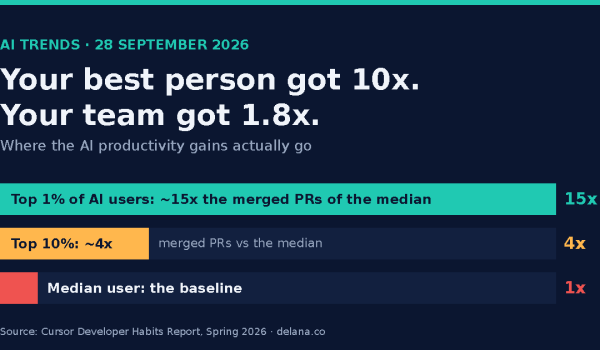
The short answer: the AI story trending among engineering and business leaders today is not a new model. It is an uncomfortable gap. Cursor’s usage data shows its top 1% of users merge about 15 times as many pull requests as the median user of the same tool, and a new executive briefing estimates that one engineer’s 10x AI speed-up shrinks to roughly 1.8x once the work moves through the rest of the team. At the same time, WorkOS told the AI Engineer conference that its purpose-built “software factory” first produced results “pretty indistinguishable” from engineers running a coding agent on their laptops. The lesson from both: AI made producing work cheap, so the bottleneck moved to reviewing, deciding and shipping it. Below: what the data shows, why teams stall, what WorkOS changed, the security gap nobody has solved, and a seven-step plan to turn individual AI gains into team results.
New to this series? Our You’re Not Competing With AI post argued the real competition is between people who use AI well and those who don’t. Today’s data shows how wide that gap has become, and why closing it is a team design problem, not a training problem.
The productivity-gap trend at a glance
- Gains are concentrated. In Cursor’s Spring 2026 Developer Habits Report, the top 1% of users merged about 15x the pull requests of the median active author and wrote about 46x the lines of code. The top 10% merged about 4x.
- The team multiplier is much smaller. An executive briefing from Nate’s Newsletter, published this weekend, puts the team-level gain from one 10x engineer at roughly 1.8x, because the constraint was never typing speed.
- More automation is not more output. WorkOS’s first software factory (a sandbox, an agent and a model router) was no better than engineers using Claude Code locally. What helped was encoding the company’s process and context.
- The security question is open. WorkOS said on stage it has not yet figured out authorization for agents that read customer Slack channels, query its data warehouse and open code changes.
1. What the data actually shows
Cursor’s inaugural Developer Habits Report, covering January 2025 to May 2026, is one of the largest public looks at how people really use AI coding tools. Lines added per developer roughly doubled year over year, and median weekly output rose from about 176 lines to about 712, according to a summary of the report. But the gains were lopsided. Cursor measured Gini coefficients of 0.77 for AI-written lines and 0.75 for AI spend, on a scale where 1 means one person has everything. Power users also work differently: 81% use subagents, against 15% of median users.
Spending shows the same shape. Jellyfish found that in May 2026 more than half of users spent under $100 a month on AI coding tools, while the 99th percentile spent about $2,452, roughly 35x the median. At the extreme, one user’s monthly bill touched the salary of a US junior developer.
Two cautions keep this honest. Pull requests and lines of code measure activity, not customer value, and the briefing itself notes that the 15x figure “doesn’t tell us that those people created fifteen times the customer value, or that AI caused the whole difference.” Heavy users may simply have been the most productive people to begin with. What the data does prove is that the same tool produces a very wide range of results, and that range is worth studying inside your own company.
2. Why 10x shrinks to 1.8x: the bottleneck moved
Writing code, drafting a report or building a first version used to be the slow step. AI made it fast. Everything after it did not speed up: someone still has to review the change, decide whether it is the right change, test it, approve it and release it. When one person starts producing ten times as much, the queue in front of reviewers and decision-makers grows ten times as fast. The work is finished; it is just waiting.
The briefing also flags a trap most managers walk into: asking the fastest person to teach everyone else. Workshops and shared prompt libraries sound sensible, but they can turn your most productive builder into a full-time trainer and consume the very capacity you were trying to multiply. The fix is to redesign the steps around the new speed, not to clone one person’s habits.
3. The software factory that wasn’t one
The second trending story this weekend shows the same problem from the company side. Many firms are building “software factories”: dedicated teams and infrastructure that let AI agents turn requests into code around the clock. At the AI Engineer conference, WorkOS engineer Ryan Cooke described building one with two parts: TARS, an agent living in Slack, Linear and GitHub, and Horizon, an orchestration layer. The first version, a cloud sandbox plus an agent and a model router, delivered nothing extra. “This was not an incremental increase or an exponential increase over engineers just driving Claude Code on their laptops,” Cooke said. “It was actually pretty indistinguishable for us.”
Three changes made the difference:
- Automating the work around the code. An agent drafts the planning document WorkOS calls a Hilltop (purpose, customer input, competitive analysis, milestones), reads human reviews and breaks the approved plan into tickets. Cooke admits it sometimes “grossly overestimates” scope, but editing a draft beats a blank page.
- An internal MCP gateway. One connection point to internal systems, with descriptions telling the agent how the company organizes its information, down to which data warehouse tables answer which questions. It became so useful that other teams now query it from Slack for customer analysis.
- Outcome metrics instead of output metrics. WorkOS stopped counting pull requests and started tracking customer impact, defect rates and recovery time, engineer adoption, and what its own session data says about where agents go wrong.
4. The security gap: faster work, thinner review
For a security team, the productivity gap has a darker side. When changes arrive faster than people can read them, review turns into rubber-stamping, and rubber-stamped AI changes are exactly where bugs, leaked secrets and over-broad permissions slip through. Cooke was candid that WorkOS has not solved authorization: he did not cover it because “we haven’t figured it out yet for ourselves,” and asked other builders to share what they do. That is a system that reads shared customer Slack channels, queries data warehouse tables and opens code changes on its own.
Why it matters: the same pattern is showing up everywhere we have covered this month, from agents getting their own employee identities to agent credentials that nobody owns. An internal MCP gateway is powerful precisely because it connects everything, which also makes it one of the most sensitive systems you will run. Give it the same access reviews, logging and least-privilege rules as any admin account, and never let review speed become the control you quietly drop to keep up.
5. The same gap, at country scale
A related trend reported by the Financial Times this weekend applies the same logic to where companies invest. Multinationals in finance, industry and tech now weigh a country’s AI talent, computing infrastructure and rules when placing new research, factories and jobs. One large US bank uses a traffic-light rating and says it is “less inclined” to add headcount in countries rated red; it called the UK “greenish” and put some mainland European countries in the weaker category. Novo Nordisk chose London for its new AI hub with Amazon Web Services. A European Commission spokesperson countered that Europe’s AI gigafactories will expand computing capacity. Whether the unit is a person, a team or a country, the organizations that turn AI into finished outcomes are pulling ahead.
Seven steps to turn individual AI gains into team results
- Find where finished work waits. For two weeks, track how long AI-assisted work sits in review, approval or testing. That queue, not the tool, is your real ceiling.
- Switch the scorecard. Report features shipped, defect rate and time to recovery. Drop PR counts and “percent written by AI” from leadership dashboards.
- Tier your reviews by risk. Low-risk changes with strong automated tests get a light review; anything touching authentication, payments, customer data or permissions gets a full human review, every time.
- Put AI on the review side too. Use AI code-review and test-generation tools so human reviewers start from a summary and a list of flagged risks, not a raw diff.
- Write your context down once. Document how your company organizes information and makes decisions, and expose it through one governed gateway so every agent and every person uses the same map.
- Study your top users, don’t just copy them. Ask what your heaviest AI users do differently (subagents, planning documents, test-first habits) and build those into team workflows, instead of turning them into full-time trainers.
- Secure the plumbing before you scale it. Give every agent its own identity, least-privilege access and logging, and keep a clear owner for the gateway. Watch spend, too: at the 99th percentile, AI bills can rival a salary, which our AI cost overruns guide covers.
Frequently asked questions
Does AI make every developer equally productive?
No. Cursor’s Spring 2026 Developer Habits Report found the top 1% of users merged about 15 times as many pull requests as the median user, and the top 10% about 4 times. Gains are highly concentrated, although pull requests measure activity rather than customer value.
Why doesn’t one engineer’s AI speed-up make the whole team faster?
Because writing was never the only bottleneck. Review, decisions, testing and release still move at human speed, so faster output mostly creates a longer queue. One recent executive briefing estimates a 10x individual gain shrinks to about 1.8x at team level.
What is an AI software factory?
It is a setup in which AI agents, usually running in cloud sandboxes, take requests and produce code changes with limited human involvement. WorkOS found a basic version performed about the same as engineers using a coding agent locally; gains came from encoding company process and context, and measuring outcomes.
What should we measure instead of pull requests?
Track outcomes: features that reach customers, defect rate and time to recovery, how long work waits for review, and whether the people doing the work actually adopt the tools. These show whether AI is creating value or just activity.
Sources: Cursor Insights (Developer Habits Report); Cursor AI statistics summary; Tech Times (Cursor developer gap); Jellyfish, State of AI in Software Engineering; Nate’s Newsletter (scaling AI developer productivity); BigGo Finance (Ryan Cooke, WorkOS); Traders Union, reporting the Financial Times; Artificially Intimidating, AI Brief 28 September 2026.